
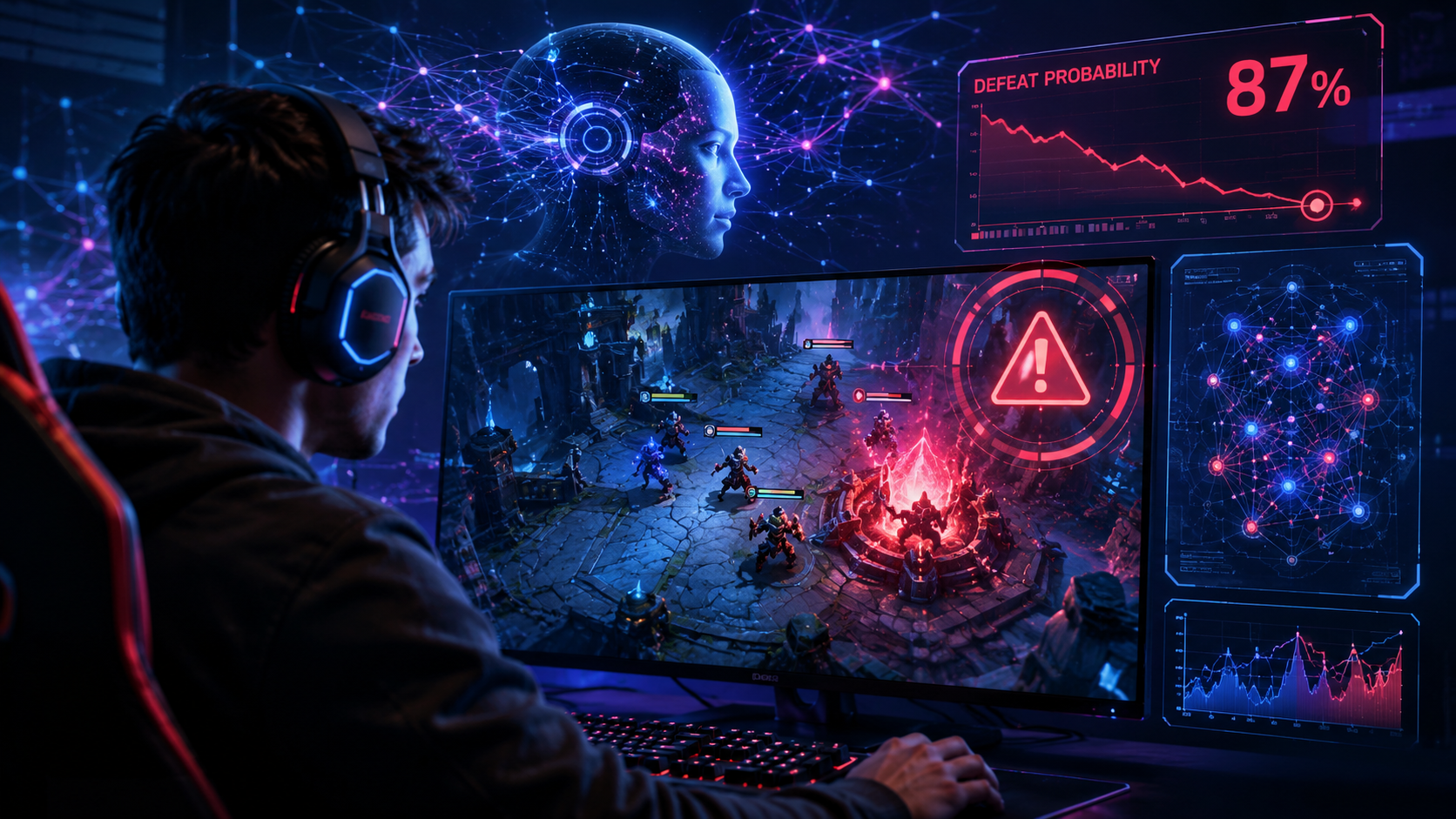
Picture this: you’re three levels deep into a mobile RPG. Your health bar is low, you’ve just burned your last potion, and there’s a boss around the corner. The game knows — not because a developer scripted that moment, but because an AI model has been watching your every tap, calculating your fatigue curve, and quietly orchestrating what comes next.
Welcome to predictive AI in gaming. It’s not science fiction. It’s already shipping on Android, and it’s about to completely change what “playing a game” even means.
Why “Adaptive Difficulty” Was Just the Beginning
Older games had a simple trick called adaptive difficulty: if you died too many times, the game quietly lowered enemy health. It was a polite lie. The game pretended to be fair while secretly pulling its punches.
Modern predictive AI works on an entirely different level. Instead of reacting to failure, it models your play style in real time — your average decision time, your preferred attack patterns, how you move when you’re panicking — and adjusts the entire experience before you even realize you’re struggling.
The shift isn’t from “hard” to “easy.” It’s from games that react to you, to games that anticipate you. That’s a fundamentally different relationship between player and software.
What Predictive AI Actually Does Inside Your Game
There are four core ways this technology is being deployed in Android titles right now — and each one is more ambitious than the last.
🎯 Behavior Modeling
Tracks tap speed, hesitation time, and movement patterns to build a real-time profile of your skill state — moment to moment.
📉 Churn Prediction
Identifies the exact moment players are about to quit — and intervenes with a reward, story beat, or difficulty shift to keep them in.
📖 Procedural Narrative
Story branches and NPC dialogue are generated dynamically based on who you are as a player — not just what you chose in a menu.
💰 Economy Balancing
In-game shops and reward schedules adapt to your spending psychology — keeping you engaged without (at its best) feeling manipulative.
The Numbers Behind the Shift
This isn’t a niche experiment. The mobile gaming industry is betting billions on predictive AI infrastructure, and the data explains why.
34%
higher 30-day retention in AI-adaptive games vs. static design
2.1×
longer average session length when difficulty is AI-tuned
$28B
projected global spend on AI in gaming by 2028
Those retention numbers matter enormously. For Android developers on the Play Store, where the average game loses 77% of its users within three days of install, any meaningful improvement in day-30 retention is the difference between a profitable title and an abandoned one.
The Android Advantage Nobody Talks About
iOS gets most of the gaming press, but Android is where predictive AI is finding its most fertile ground. The open nature of the ecosystem means developers can instrument their games far more deeply — collecting richer behavioral data, pushing model updates without app store approval cycles, and integrating cloud inference at a pace Apple’s walled garden simply doesn’t allow.
Pair that with the explosion of Android TV and Smart TV setups running Android-based gaming launchers, and you have a hardware footprint that spans pocket to living room. A predictive AI system that learns how you play on your phone can carry that model to your TV session — and your next session, and the one after that.
The best game you’ve ever played won’t feel like it was designed. It will feel like it was designed for you.
The Ethical Layer: When Does Adaptive Become Manipulative?
Here’s the tension the industry is not yet resolving cleanly. If an AI can predict when you’re about to quit and serve you a perfectly timed dopamine hit — a rare item drop, a storyline twist, an unexpected win — is that great design or engineered compulsion?
The most thoughtful developers are building opt-in transparency layers: letting players see their own behavioral profiles, choose their AI difficulty mode explicitly, or turn predictive features off entirely. That’s the direction Tech Play Games believes the industry needs to move. An AI that plays fair with you, not just on you.
What This Means for Your Setup
Practically speaking, the more powerful predictive AI systems run inference in the cloud, not on-device. That means your connection quality matters more than it ever has for gaming. If you’re running an Android TV or smart TV setup, a stable low-latency connection isn’t just about smooth video — it’s about whether the AI brain of your game is getting the real-time data it needs to stay calibrated to you.
On the device side, look for titles that explicitly mention “personalized difficulty,” “AI game master,” or “dynamic narrative” in their Play Store descriptions. These are the early signals that a game is using genuine predictive modeling rather than old adaptive difficulty tricks dressed up in new marketing language.
The Tech-Play Perspective
We’ve covered how AI Agents are reshaping everything from web browsing to content creation. Gaming might be where those changes hit the most people, most viscerally. Unlike a smarter search result or a better email draft, an AI that learns how you play and responds in kind is something you feel — in the moment, in your gut, in that split second when the game does exactly what you needed it to do.
That’s not just better software. That’s a new kind of play. And it’s arriving on Android first.
What game mechanic would you most want an AI to personalize for you? Drop it in the comments — we read every one.