
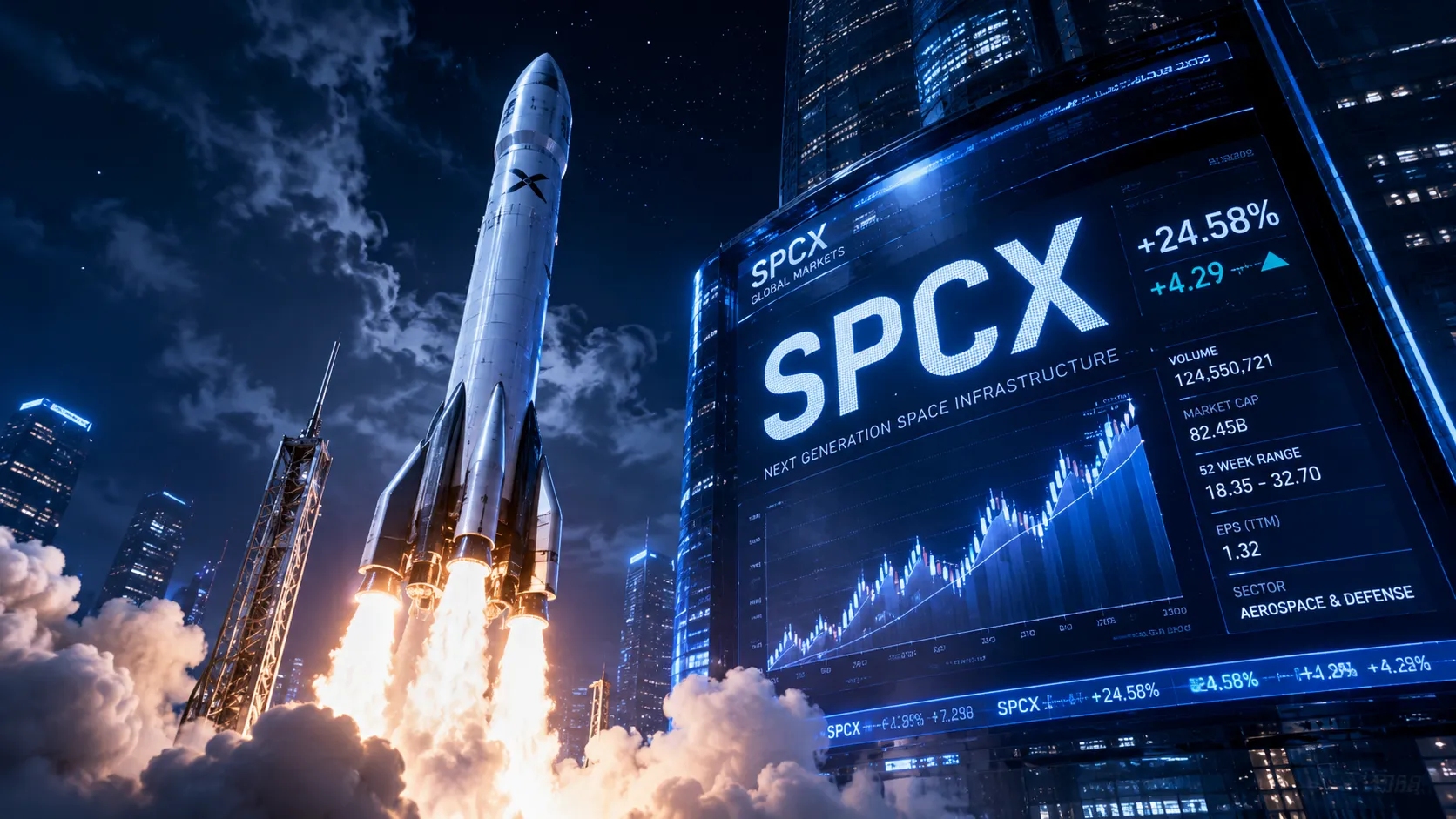
SpaceX stock SPCX has finally turned one of the world’s most watched private tech companies into a public-market spectacle. The first days on the Nasdaq were not quiet, not normal, and definitely not boring.
For investors, tech fans, and anyone following Elon Musk’s business empire, SPCX is more than another ticker. It is a live test of how much the public market is willing to pay for rockets, satellites, Starlink, AI ambitions, and a future that still sounds like science fiction.
SpaceX stock SPCX: Why the Nasdaq Debut Matters
The SpaceX Nasdaq debut matters because it gives everyday investors a direct way to follow the company’s market value in real time. Before the IPO, SpaceX was famous, valuable, and discussed everywhere, but access to shares was mostly limited to private investors, employees, funds, and secondary-market buyers.
That changed when SPCX began trading publicly. Suddenly, the market could price SpaceX minute by minute, just like Nvidia, Tesla, Amazon, Apple, or Microsoft.
The most important insight is simple: SpaceX did not enter the market like a normal industrial company — it entered like a new category of mega-cap technology.
That is why the first days of trading received so much attention. SpaceX is not only a rocket manufacturer. It is also tied to satellite internet, launch infrastructure, defense contracts, AI narratives, robotics possibilities, and the long-term dream of commercial space expansion.
This mix makes the stock exciting. It also makes it complicated.
What Happened on the SpaceX Stock First Day?
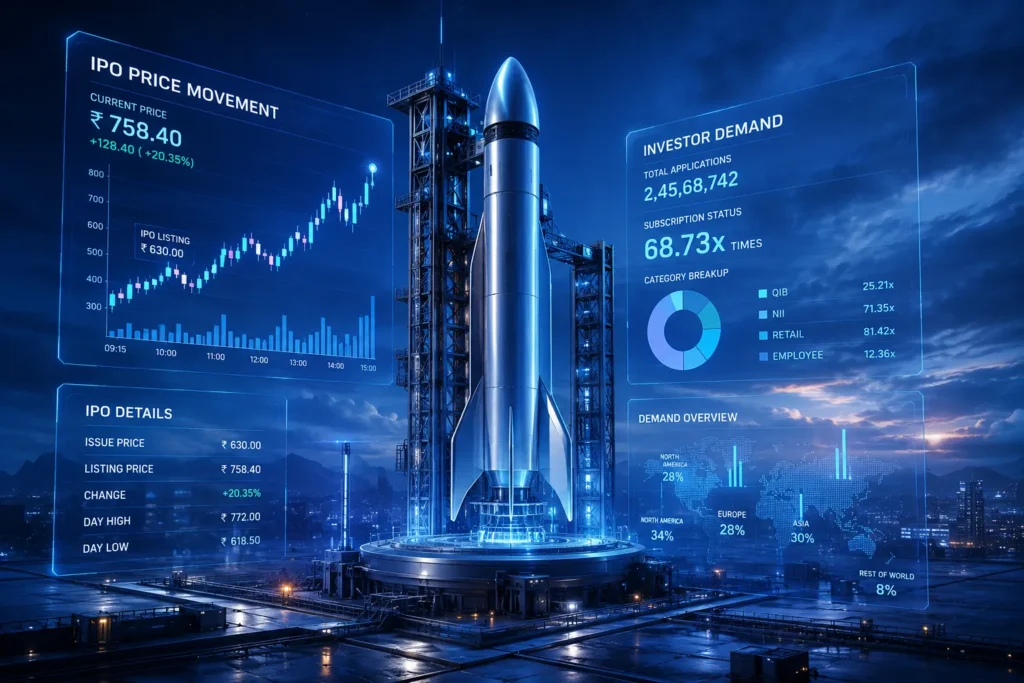
The SpaceX stock first day gave investors exactly what they expected: huge attention, heavy trading, and a powerful opening move. The IPO price was set at $135 per share, and trading opened above that level at $150.
By the close of the first trading day, SPCX finished at $160.95. That first-day move instantly placed SpaceX among the most valuable public companies in the world.
For a normal IPO, a double-digit first-day jump would already be big news. For SpaceX, it became part of a much larger story: the company was not just joining the stock market; it was challenging the market’s understanding of what a space company can be worth.
The first-day performance showed that investors were not only buying SpaceX’s current business — they were buying the future story.
That future story includes several powerful themes:
- Reusable rockets becoming normal infrastructure
- Starlink expanding global internet access
- Government and defense demand for space services
- Commercial satellite growth
- Potential Mars and deep-space ambitions
- AI and automation across Musk-linked companies
- The possibility of SpaceX becoming a platform company, not just a manufacturer
This is why the SpaceX IPO felt different from many traditional public offerings. It was not only a financial event. It was a cultural and technology moment.
SPCX Stock Price: Why the First Days Were So Volatile
The SPCX stock price moved fast because demand, emotion, and limited supply collided at the same time. A famous company with a massive fan base, a powerful founder, and a limited public float can create extreme early trading pressure.
When a company like SpaceX goes public, investors do not all enter the market with the same mindset. Some are long-term believers. Some are short-term traders. Some are institutions that need exposure. Others simply fear missing out.
That combination can create sharp moves in both directions.
The biggest lesson from the first trading days is that a great company can still become a very volatile stock.
Early IPO volatility often happens for several reasons:
- Price discovery is still happening.
The market is trying to decide what the company is really worth. - Media attention increases emotional buying.
Headlines can bring in retail demand very quickly. - Short-term traders look for momentum.
Fast price moves attract even more fast money. - Institutions may wait before building full positions.
Some funds do not buy immediately on day one. - Valuation debates become louder.
Every analyst, trader, and investor starts comparing the stock to other mega-cap companies.
The first days of SPCX showed all of these forces at once. That does not automatically mean the stock is bad or good. It means the market is still processing one of the biggest technology IPOs ever.
SpaceX IPO: What Investors Were Really Buying
The SpaceX IPO was not just about rockets. That is the key point many casual readers miss.
A traditional aerospace company is usually valued on manufacturing, contracts, margins, and backlog. SpaceX has those elements, but it also has something more powerful in the eyes of investors: a platform narrative.
Starlink gives SpaceX a recurring revenue story. Launch services give it infrastructure power. Satellite networks give it global scale. Government partnerships give it strategic relevance.
Investors were not only buying launch revenue; they were buying the idea that SpaceX could become the backbone of the commercial space economy.
That is why the market reaction was so intense. SpaceX sits at the intersection of multiple major themes:
- Aerospace
- Telecommunications
- Defense technology
- Satellite internet
- AI infrastructure
- Robotics
- Global connectivity
- Commercial space logistics
Each theme can support a strong investment story. Together, they create a rare kind of hype.
But hype is not the same as guaranteed profit. A public company must eventually prove itself through revenue growth, margins, cash flow, and execution.
That is where the next phase of the story begins.
Elon Musk SpaceX Stock: The Founder Factor
No discussion of Elon Musk SpaceX stock is complete without talking about the founder effect. Elon Musk is one of the most influential business figures in modern technology, and his name alone can move attention, capital, and sentiment.
That can be a strength. It can also be a risk.
Musk brings a track record of building companies that reshape industries. Tesla changed electric vehicles. SpaceX changed rocket economics. Starlink changed the satellite internet conversation.
The Musk factor gives SpaceX a powerful storytelling advantage, but it also increases the stock’s sensitivity to headlines.
Investors must understand this clearly. When a company is closely connected to a famous founder, the stock can react not only to earnings, but also to interviews, social media posts, political debates, product announcements, legal issues, and public perception.
That does not make SPCX uninvestable. It means the stock may behave differently from a boring industrial company.
For long-term investors, the question is not only “Do I believe in Elon Musk?” The better question is: “Can SpaceX as a public company keep delivering results that justify its valuation?”
That question will become more important with every earnings report.
SpaceX Market Cap: Why the Valuation Debate Is So Intense
The SpaceX market cap became one of the biggest talking points immediately after the Nasdaq debut. When a company reaches a trillion-dollar-plus valuation range, investors naturally compare it with the biggest technology companies in the world.
That comparison is powerful, but also dangerous.
Microsoft, Apple, Nvidia, Amazon, and Alphabet have enormous profits, global customer bases, and proven public-market histories. SpaceX has extraordinary technology and a strong growth story, but public investors will now expect more transparency and financial discipline.
The valuation debate comes down to one question: can SpaceX grow into the price the market is already giving it?
A high market cap can be justified if growth is massive, margins improve, and the company becomes essential infrastructure. But if expectations are too high, even strong business results may not be enough to satisfy investors.
That is the uncomfortable part of hot IPOs. A company can execute well and still see its stock fall if the starting valuation is too aggressive.
This is why readers should separate two ideas:
- SpaceX may be one of the most important technology companies in the world.
- SPCX may still be risky at certain price levels.
Both statements can be true at the same time.

What Makes SpaceX Different From Other Public Tech Stocks?
SpaceX is different because it combines hardware, software, infrastructure, and national strategic importance. Most public tech companies are easier to categorize. SpaceX is not.
It builds rockets, operates satellite networks, sells internet service, supports government missions, and pushes long-term space transportation goals. That makes it one of the most unusual companies on the Nasdaq.
SpaceX is not just a space stock — it is a technology infrastructure stock with aerospace risk.
This matters for investors because different parts of the business may deserve different valuation methods.
Launch services may be valued like aerospace infrastructure. Starlink may be valued more like telecom or internet infrastructure. Defense work may be compared with government contractors. Future projects may be valued like high-risk venture-style growth.
That creates a challenge. There is no simple comparison.
Tesla comparisons will appear because of Musk. Nvidia comparisons may appear because of AI and infrastructure hype. Amazon comparisons may appear because of long-term reinvestment and platform building.
But SpaceX is not exactly any of them.
That uniqueness is part of the excitement. It is also part of the risk.
The Bull Case for SPCX
The bull case for SPCX is easy to understand. SpaceX has brand power, technology leadership, and a massive total addressable market.
If the company keeps reducing launch costs, expanding Starlink, winning government contracts, and building new space infrastructure, its revenue base could become much larger over time. The market loves companies that can dominate a category before the category becomes fully mature.
The strongest bull case is that SpaceX becomes the operating system for the space economy.
Supporters may point to several possible growth drivers:
- More satellite launches for private and government customers
- Starlink subscriber growth across more countries
- Enterprise and aviation connectivity
- Maritime internet services
- Defense and national security contracts
- Future lunar and Mars-related infrastructure
- Potential partnerships with telecom and cloud providers
- New services built on top of orbital infrastructure
This is why some investors see SpaceX as more than a rocket company. They see it as a future utility for space-based connectivity and transportation.
If that view is correct, the early valuation may look less extreme years from now.
But that is a big “if.”
The Bear Case for SPCX
The bear case is not that SpaceX is unimportant. The bear case is that the stock price may already assume too much future success.
High-growth technology stocks can become dangerous when investors price in perfection. SpaceX must now prove that it can turn ambition into public-company financial results.
The biggest risk is not that SpaceX lacks vision — it is that the market may have paid too much for the vision too early.
The bear case includes several concerns:
- The valuation may be extremely demanding.
- Rocket and satellite businesses are capital intensive.
- Starlink growth may face regulatory and competitive pressure.
- Public investors may become less patient with losses or heavy spending.
- Future share unlocks could increase supply.
- Earnings reports may create sharp price reactions.
- Any launch failure or operational issue could hurt sentiment.
- Musk-related headlines may add volatility.
These risks do not cancel the long-term opportunity. But they do mean investors should avoid treating SPCX like a guaranteed winner.
A great company can still be a difficult stock.
What Should Investors Watch After the SpaceX Nasdaq Debut?
After the SpaceX Nasdaq debut, the first trading days are only the beginning. The real story will develop over the next few quarters as investors get more financial data and management commentary.
The most important things to watch are not daily price moves. They are business signals.
The key is to watch whether SpaceX’s fundamentals start catching up with its market value.
Here are the most important signals:
1. Revenue Growth
Investors will want to see how fast SpaceX is growing across Starlink, launch services, government contracts, and commercial customers. Strong revenue growth can support a premium valuation.
2. Profitability and Cash Flow
Revenue alone is not enough. The market will focus on margins, operating losses or profits, capital spending, and free cash flow.
3. Starlink Subscriber Momentum
Starlink is central to the public-market story. Subscriber growth, average revenue per user, enterprise adoption, and international expansion will matter.
4. Launch Cadence
A higher launch cadence can show operational strength. It can also support the idea that SpaceX has a cost advantage against competitors.
5. Index Inclusion
If SPCX enters major indexes, passive funds may need to buy shares. That can create demand, but it does not remove valuation risk.
6. Share Lockups
When early investors and insiders are allowed to sell more shares, supply can increase. That can pressure the stock, especially if demand cools.
7. Regulatory and Geopolitical Risk
Space is strategic. Governments care about satellites, defense contracts, spectrum rights, and launch access. This can help SpaceX, but it can also create political and regulatory complexity.
Should You Buy SpaceX Stock SPCX Now?
This article is not financial advice, but it can help you think more clearly. Whether someone should buy SpaceX stock SPCX depends on risk tolerance, time horizon, portfolio size, and belief in the company’s long-term execution.
For short-term traders, SPCX may offer action, volatility, and headlines. For long-term investors, the question is whether SpaceX can grow into one of the most valuable companies in the world without disappointing public-market expectations.
The smartest approach is to separate excitement about SpaceX from discipline about the stock price.
Before buying any hot IPO, investors should ask:
- Am I buying because I understand the business or because of hype?
- Can I handle a 20%, 30%, or even 50% drawdown?
- Do I know what valuation I am paying?
- Is this position small enough to survive volatility?
- Am I investing for years or trading for days?
- What would make me sell?
These questions matter because hot stocks can make people emotional. SpaceX is exciting, but excitement is not a risk-management strategy.
A balanced investor can admire the company and still wait for a better entry point. Another investor may accept the risk because they believe the long-term upside is worth it.
There is no one-size-fits-all answer.
SpaceX Stock SPCX and the Future of the Space Economy
The arrival of SPCX on the Nasdaq could change how investors think about the space economy. For years, space investing felt niche, speculative, or indirect. Now, one of the most important private space companies has become a public benchmark.
That could attract more attention to satellite companies, launch providers, defense-tech firms, space ETFs, and infrastructure suppliers. It could also inspire more private space companies to consider public listings.
SPCX may become the stock that turns space investing from a niche theme into a mainstream market category.
This does not mean every space stock will win. In fact, the opposite may happen. As more investors study the sector, weak companies may be exposed faster.
But SpaceX gives the market a new reference point. Analysts can now compare other space companies against the leader. Investors can watch how revenue, margins, and growth are valued in real time.
That makes SPCX important even for people who never buy the stock.
It becomes a signal for the entire sector.
What the First Days Tell Us About Investor Psychology
The first days of SpaceX stock trading revealed something important about modern markets. Investors are not only buying earnings. They are buying stories, networks, founders, scarcity, and future optionality.
SpaceX has all of those ingredients.
It has a famous founder. It has a powerful mission. It has real technology. It has public fascination. It has business lines that could become much bigger.
The first days of SPCX showed that narrative can move markets before fundamentals have fully caught up.
That does not make the move irrational by default. Great technology companies often look expensive early. But it does mean investors need to be careful.
A story can create momentum. Only execution can sustain it.
That is the line SpaceX must now walk as a public company.
Frequently Asked Questions
Is SpaceX stock SPCX publicly traded?
Yes, SpaceX stock SPCX is now publicly traded on the Nasdaq. The IPO turned SpaceX from a private company into a public stock that investors can follow under the SPCX ticker.
What was the SpaceX IPO price?
The SpaceX IPO price was set at $135 per share. The stock opened above the IPO price, showing strong early demand from public-market investors.
What happened on the first day of SPCX trading?
On the first trading day, SPCX opened at $150 and closed at $160.95. That strong first-day move helped push SpaceX into the top tier of global public companies by market value.
Is SPCX stock risky after the Nasdaq debut?
Yes, SPCX can be risky because the valuation is high and the stock has shown major early volatility. Investors should watch earnings, Starlink growth, share unlocks, and overall market sentiment.
Does Elon Musk own SpaceX stock?
Elon Musk has long been closely tied to SpaceX as founder and key leader. The public listing makes Elon Musk SpaceX stock a major market topic because investor sentiment around Musk can influence how the stock trades.
Conclusion: SpaceX Stock SPCX Is a New Market Era
SpaceX stock SPCX is more than a ticker. It is the public-market debut of a company that has changed rockets, satellite internet, and the commercial space conversation.
The first days on the Nasdaq showed huge demand, extreme attention, and serious valuation questions. The company may become one of the defining technology platforms of the next decade, but the stock still needs to prove that its fundamentals can support the market’s expectations.
The real story begins after the IPO hype fades.
If SpaceX delivers growth, improves financial transparency, and turns its space infrastructure into durable profits, SPCX could become one of the most important tech stocks in the world. If expectations run too far ahead of reality, the first days may be remembered as the easy part.
Want more smart, easy-to-read tech market explainers? Download the Tech-Feed app and follow tech-play.net for fast updates on AI, apps, space, and the biggest technology trends shaping tomorrow.