
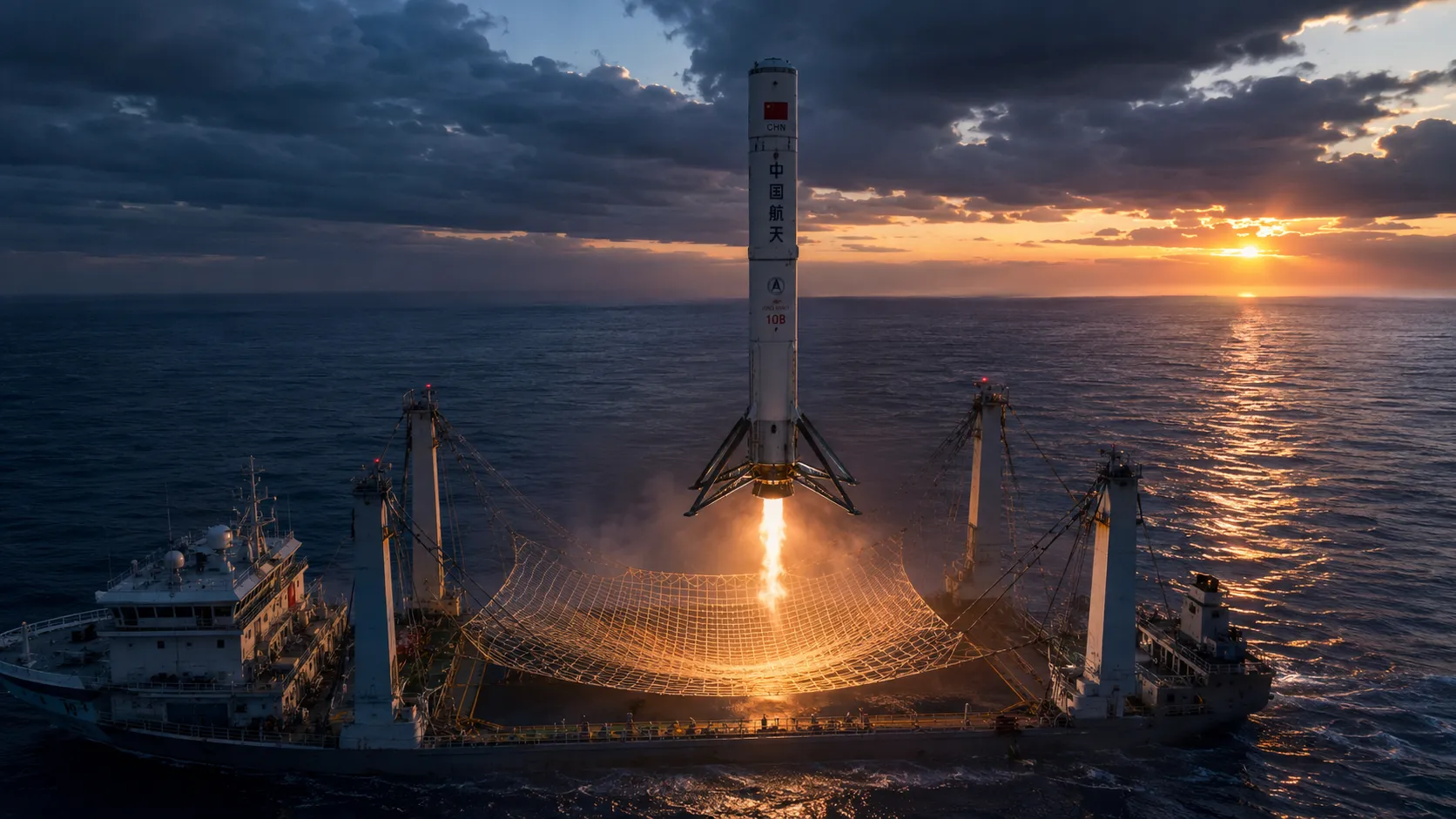
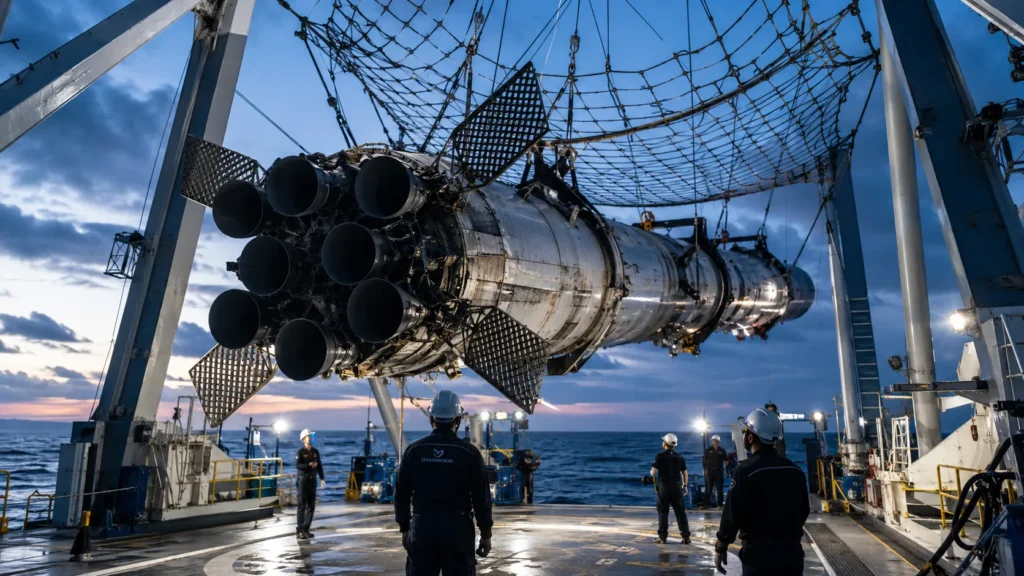
The Long March 10B rocket landing made history on July 10, 2026, when China successfully recovered the first stage of an orbital rocket after its maiden launch. Instead of touching down on landing legs, the booster was caught by a tensioned cable net aboard a recovery ship in the South China Sea.
The Long March 10B rocket landing was not merely China’s first successful recovery of an orbital-class booster; it was also the first flawless first-stage recovery achieved on a rocket’s debut launch. ned Over the South China Sea
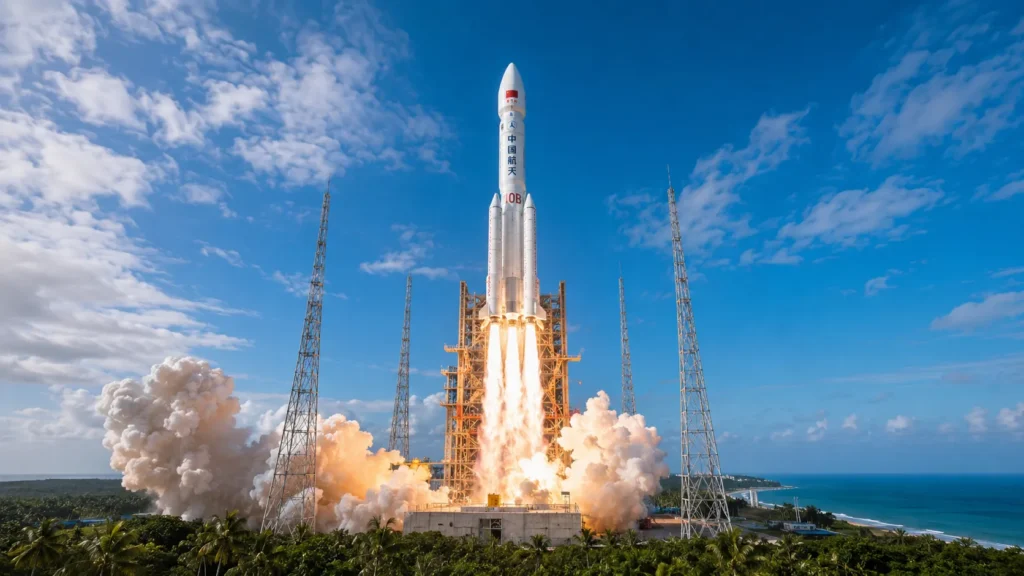
The roughly 63-meter-tall rocket launched from the Wenchang Commercial Space Launch Site in Hainan. Its first stage burned kerosene and liquid oxygen through seven YF-100K engines, while the second stage used methane and liquid oxygen to continue toward orbit. eparation, the booster began the part of the mission that had defeated earlier Chinese attempts. It coasted back, adjusted its attitude, slowed through aerodynamic drag and powered braking, and used grid fins to steer toward the recovery vessel Linghanzhe.
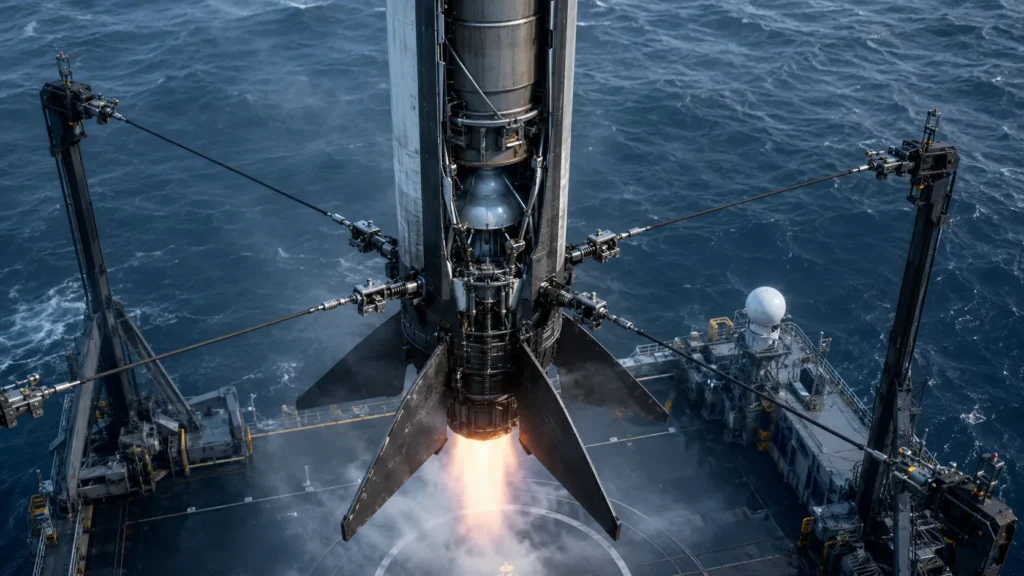
Near the ship, the booster relit one of its seven engines for the final descent. Instead of extending landing legs, it aimed for a tensioned cable net. Hooks on the vehicle engaged the capture system, allowing the platform to absorb the remaining motion and hold the stage above the deck. ot simply land a booster; it demonstrated a distinctly different recovery architecture on the first orbital flight of the rocket carrying it.**
Why Landing an Orbital Booster Is So Difficult
A first stage begins its trip home only after doing the most violent part of the launch. It has accelerated a large vehicle through the lower atmosphere, consumed most of its propellant, separated at high speed, and ended up far from the launch site.
From there, the booster has to reverse from “rocket going to space” into “precision aircraft with almost no room for error.” It must control its orientation, survive heating and aerodynamic forces, find a moving target at sea, restart engines reliably, and reduce its speed at exactly the right moment.
Too much thrust and it overshoots. Too little and it hits hard. A steering error measured in only a small part of the full return path can become a miss at the recovery platform. The ocean adds wind, waves and ship movement to an already unforgiving problem.
That is why the debut-flight detail matters. SpaceX built its recovery record through repeated attempts, failures and refinements. China’s Zhuque-3 and Long March 12A reached orbit during recovery attempts in December 2025, but their boosters did not complete the landing. Long March 10B succeeded on its first launch. very does not prove that every future booster will return safely. It does prove that the guidance, engine restart, grid-fin control and capture hardware worked together under real orbital-flight conditions.
How the Net-Capture Landing Works
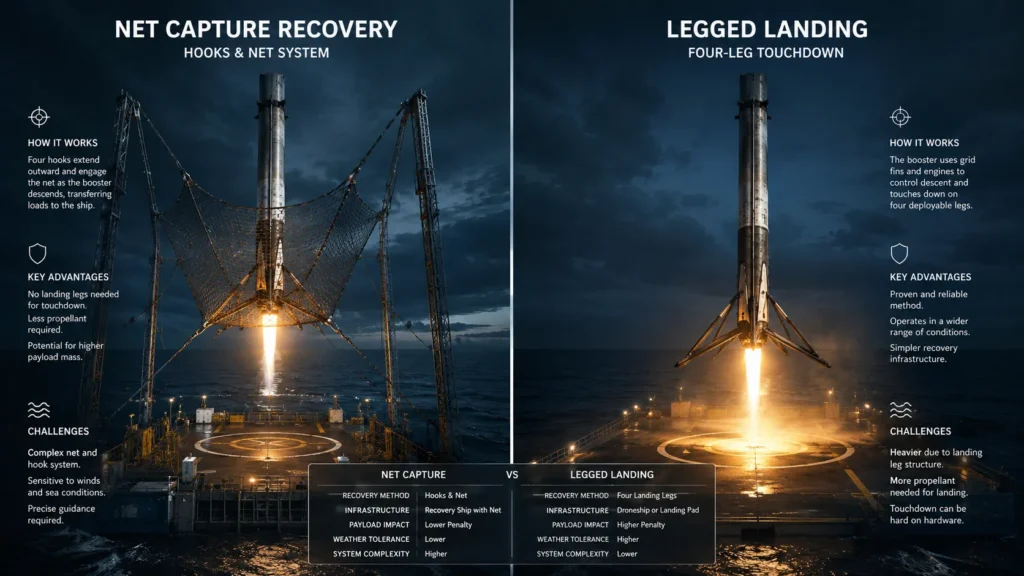
SpaceX’s Falcon 9 descends onto landing legs. Blue Origin’s New Glenn also uses a powered vertical landing with legs. The Long March 10B removes that final piece of onboard hardware and makes the recovery platform do more of the work. s surprisingly easy to picture. Imagine a tall booster descending through the center of a large, tensioned web. Hooks mounted on the rocket catch the cables. The net and its damping system then spread and absorb the energy that would otherwise pass through landing legs into a ship’s deck.
That approach can offer useful trade-offs. Landing legs add mass, mechanisms and structural demands to the rocket. Hooks are comparatively simple and light. A broad capture area may also tolerate some position error that would be dangerous when trying to place several legs onto a limited deck. that the ship becomes more complex. The net must be correctly tensioned, the supporting structure must handle a huge moving load, and the system has to react safely if the booster arrives slightly off-center. Recovery teams must also secure and transport a tall stage that is hanging in the capture structure rather than standing on its own legs.
Net capture shifts part of the landing problem from the rocket to the recovery vessel.
Long March 10B Versus SpaceX: Same Goal, Different Answer
It is tempting to describe every returning rocket as “China’s Falcon 9.” The comparison is useful up to a point: both vehicles preserve the expensive first stage instead of throwing it into the sea, and both rely on an engine relight plus aerodynamic steering to reach a recovery zone.
The last seconds are where the philosophies split. Falcon 9 carries legs and lands on them. Long March 10B uses hooks and lets the ship’s net complete the catch. SpaceX keeps more landing equipment on the booster; China’s design transfers more equipment to the recovery platform.
There is also a major difference in maturity. SpaceX has turned booster recovery into a routine part of its launch service. Long March 10B has completed one successful mission. China’s next challenge is not producing another dramatic video. It is inspecting the recovered stage, preparing it efficiently, and flying it again without rebuilding so much hardware that the economic benefit disappears. ers when comparing the recovery with Starship Flight 12 and SpaceX’s iterative test program. A reusable rocket becomes commercially powerful only when recovery is repeatable, refurbishment is controlled, and launch cadence rises.
Still, first attempts count. The July 10 flight showed that China is no longer discussing orbital booster recovery as a future capability. It has physically brought one back.
Why This Matters for China’s Space Race
Reusability is mainly about economics and tempo. The first stage contains engines, tanks, avionics and structures that took time and money to build. Recovering it creates the possibility of inspecting, refueling and flying that hardware again rather than manufacturing a replacement for every mission.
Lower cost is only one benefit. A reusable fleet can support more frequent launches, which matters for large satellite constellations, commercial payloads, technology demonstrations and national programs. The country that can launch often gains more chances to improve vehicles, deploy infrastructure and respond when plans change.
The Long March 10B also belongs to a wider family of rockets connected to China’s crewed and lunar ambitions. The commercial vehicle is not itself the complete answer to a Moon landing, but its engines, operations and recovery experience can feed a broader launch program. the story connects with NASA’s Artemis plans and the emerging Moon-base competition. The modern space race is not one sprint to plant a flag. It involves launch cadence, reusable transport, lunar logistics, communications, satellites and the ability to keep programs moving for years.
The strategic advantage is not owning one recoverable booster; it is building a launch system that can fly often enough to change what missions are affordable.
China now stands beside SpaceX and Blue Origin in the small group that has developed and operated recoverable orbital rocket systems. It has not matched SpaceX’s operational experience, but the technical gap is no longer the same gap it was before July 10. ns Next
China plans to refly the recovered booster before the end of 2026. That mission may be even more revealing than the maiden launch. l need to inspect the YF-100K engines, tanks, heat-exposed structures, grid fins, hooks and avionics. They will also learn how the net capture affects the stage mechanically. A soft catch can still produce loads in places that differ from those created by a landing on legs.
The most important questions are practical:
- How much refurbishment does the booster require?
- Can the engines restart and perform reliably on another orbital mission?
- Does the net system shorten or complicate recovery operations?
- Can the same approach work across changing sea and weather conditions?
- How quickly can China repeat the process?
A successful reflight would move Long March 10B from “recovered rocket” toward a genuinely reusable launch service. Repeated recoveries would matter even more, because consistency is what turns an engineering achievement into infrastructure.
Frequently Asked Questions
Did China really land a reusable rocket?
China successfully recovered the first stage of the Long March 10B after an orbital launch on July 10, 2026. The booster was captured by a net system on a sea-based recovery platform rather than touching down on conventional landing legs. arch 10B fully reusable?
No. The July mission recovered the first stage, making the vehicle partially reusable. The second stage continued toward orbit and was not part of the recovery.
How is the Chinese rocket landing different from Falcon 9?
Falcon 9 lands vertically on deployable legs. Long March 10B descends into a tensioned cable system, where hooks on the booster engage a large net mounted on the recovery vessel. China want reusable rockets?
Recovering the most expensive part of a launch vehicle can reduce the need to build a new first stage for every mission. It can also support higher launch frequency for satellites, commercial missions and wider national space goals.
Will the recovered Long March 10B booster fly again?
China plans to refly the booster before the end of 2026. That reflight will be a key test of inspection, refurbishment and the real operational value of the recovery system. ong March 10B Rocket Landing Changes
The Long March 10B rocket landing changes the conversation because China has moved from failed recovery attempts to a complete orbital launch and controlled sea catch. The method is different, the rocket succeeded on debut, and the recovered booster is already intended to fly again.
The next benchmark is tougher: repeat the feat, shorten the turnaround and show that the hardware can survive multiple missions. If China does that, the net hanging above Linghanzhe’s deck will be remembered not as a clever one-off, but as the moment a new reusable launch system began to take shape.
See how this recovery fits into the larger race back to the Moon in NASA’s Moon Base and Artemis 2026.



Great content! Keep up the good work!