
AI tech stocks ended October under pressure as investors questioned how quickly enormous infrastructure investments would produce cash returns. Alphabet’s sharp fall on Thursday, October 29, was followed by a wider technology sell-off on Friday, October 30, after Amazon and Intel reported. The Nasdaq Composite lost 2.86% on Friday, compared with 1.82% for the S&P 500. Reuters’ closing report linked the decline to disappointing results and concerns about AI spending.
The central issue was the gap between business growth, cash generation and the expectations already built into share prices. Strong demand can coexist with an expensive investment cycle—and a falling stock.
Market window: U.S. regular trading sessions on October 29–30, 2026. Researched November 1. Outlook covers the following two to four weeks; it describes possible outcomes rather than a trading recommendation.
AI tech stocks: The two-day market picture
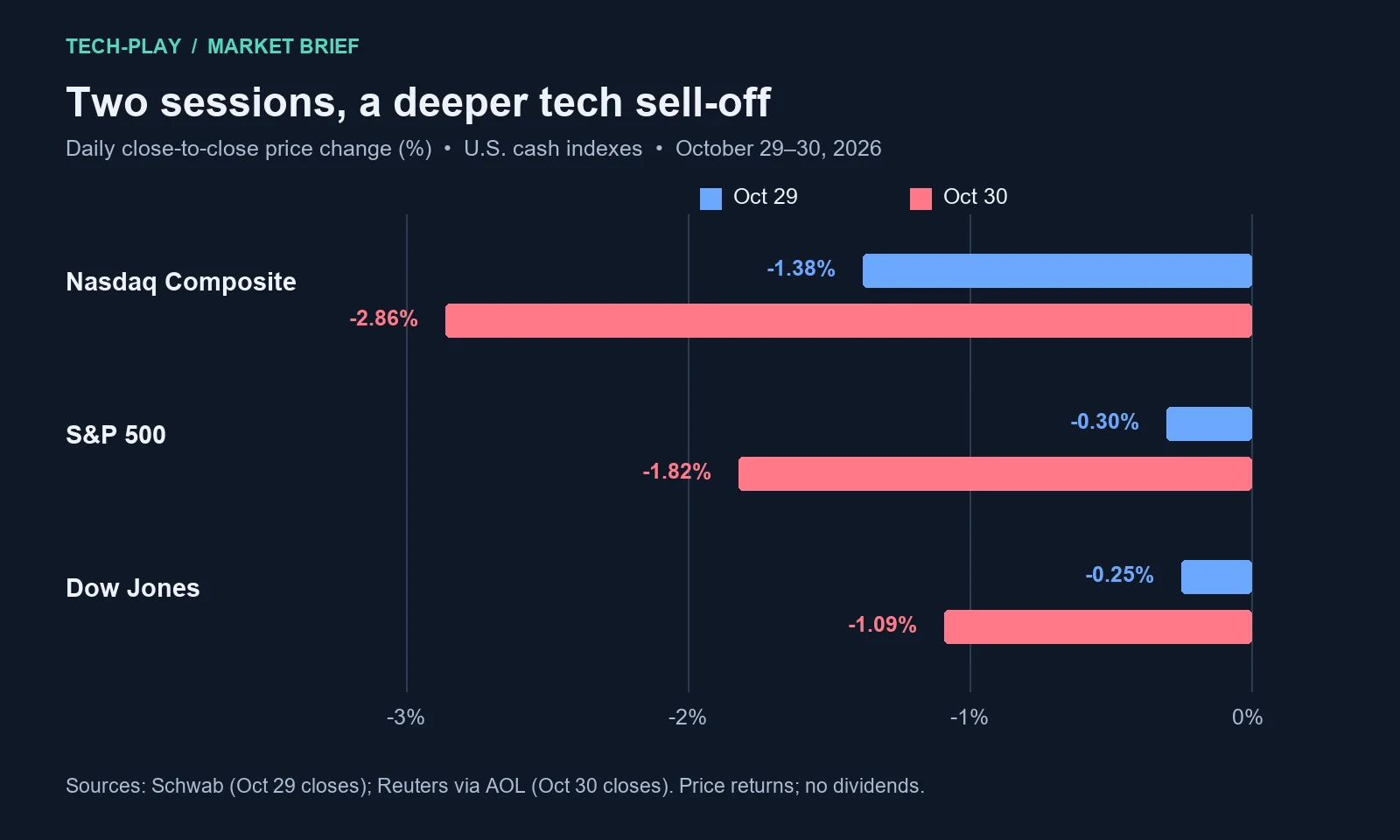
Daily price changes from the preceding regular-session close. Thursday figures come from Schwab’s pre-open report on October 30; Friday figures come from Reuters’ final closing report. These are separate daily returns, not a two-day total.
| Index | October 29 change | October 30 change | October 30 close |
|---|---|---|---|
| Nasdaq Composite | −1.38% | −2.86% | 25,437.00 |
| S&P 500 | −0.30% | −1.82% | 7,580.07 |
| Dow Jones Industrial Average | −0.25% | −1.09% | 51,770.31 |
Thursday’s index losses concealed a more resilient market underneath: most shares rose, according to CME’s session recap. A handful of heavily weighted technology companies pulled the headline indexes lower. That distinction matters when judging whether weakness reflects a particular investment theme or the broader economy.
October 29: Alphabet brought the cash-flow question forward
Alphabet’s Class A shares fell about 12.6% on Thursday, their worst day since they began trading, according to Associated Press reporting. The reaction followed its October 28 earnings release.
Alphabet’s filing shows revenue rising 25% to $127.6 billion and Google Cloud revenue rising 103%. Yet quarterly operating cash flow of $42.3 billion was below $51.4 billion in property and equipment purchases, leaving free cash flow negative by roughly $9.1 billion.
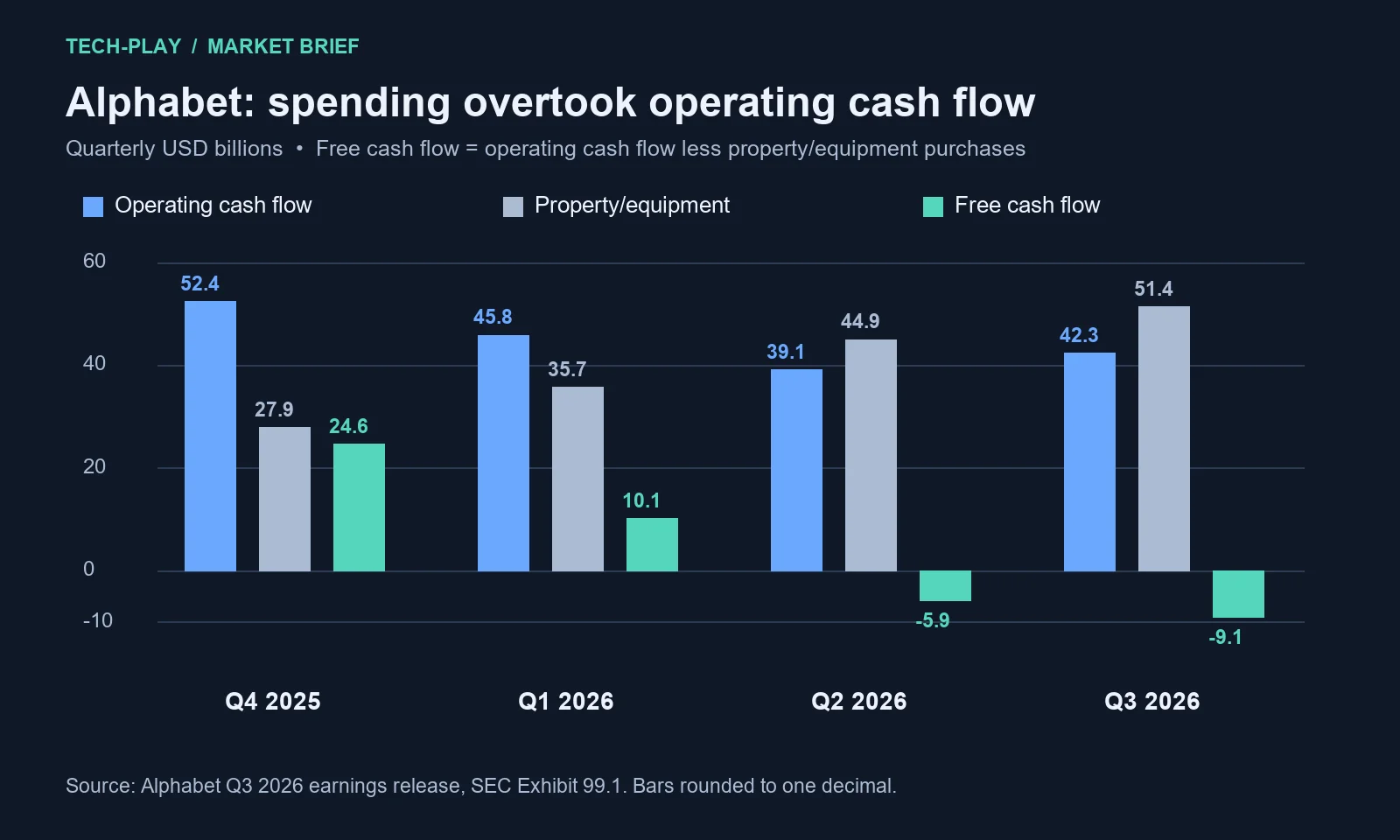
Source: Alphabet’s Q3 2026 earnings release. Quarterly USD billions, rounded to one decimal; property and equipment purchases are broader than AI alone.
Spending overtook operating cash flow in Q2 and remained higher in Q3. Future returns remain uncertain.
Alphabet’s diluted earnings per share fell to $2.12 from $2.87, while operating income increased and other income swung to a loss. EPS alone therefore gives an incomplete picture.
Microsoft offered a different growth picture. Its October 28 release reported revenue of $92.3 billion, up 19%, and Azure revenue growth of 48%. Schwab’s subsequent commentary highlighted Microsoft’s still-positive quarterly free cash flow. Cloud growth and the ability to fund investment therefore deserve separate attention.
October 30: Intel’s outlook intensified the chip sell-off
Amazon and Intel released results after Thursday’s regular session. Friday was the first full trading day for investors to digest those announcements.
Intel reported third-quarter revenue of $16.5 billion, but projected fourth-quarter revenue of $15 billion–$16 billion and adjusted earnings of $0.25 per share. Schwab reported that the revenue outlook was below the $17.29 billion FactSet consensus. The backward-looking revenue figure could not remove concerns about what came next.
The selling spread across chipmakers. Reuters reported these Friday declines:
| Stock or industry index | October 30 change |
|---|---|
| Intel | −28.6% |
| AMD | −10.9% |
| Nvidia | −4.2% |
| Philadelphia semiconductor index | −7.2% |
Rounded daily price changes from Reuters’ closing report. These are Friday moves, not weekly returns.
Intel’s outlook is evidence about Intel; it cannot establish the demand outlook for every AI supplier. The broader falls show that investors also reduced exposure elsewhere in the supply chain.
Amazon: Fast cloud growth, a large cash bill
Amazon’s October 29 results illustrated the tension. AWS revenue rose 39% to $46 billion. Over the trailing twelve months, operating cash flow reached $168.3 billion, but property and equipment purchases, net of sales and incentives, reached about $210.7 billion. Free cash flow was therefore an outflow of $42.4 billion. Amazon attributed the spending increase primarily to AI investment.
Those figures describe different periods: AWS sales are for one quarter, while the cash-flow figures cover twelve months. They should not be compared as if they were the same measure. They nevertheless explain why investors can welcome cloud demand while questioning the cost and timing of expansion.
For more context on the industry’s spending priorities, see Tech-Play’s related coverage of Big Tech investment in AI infrastructure and its workforce implications.
What could happen in the next few weeks?
Our reading of the evidence is that cash generation and investment discipline could remain central to market reactions. The reports do not establish a reliable direction for share prices. Three scenarios help identify what would change the picture.
| Scenario | Signals to watch | Possible market implication |
|---|---|---|
| Confidence improves | New results support cloud demand, margins and credible funding plans | Investors could regain confidence in selected AI companies. A rebound would still need support from subsequent results. |
| Companies diverge | Strong demand continues, but cash-flow outcomes vary substantially | Profitable, better-funded companies could hold up better than peers facing financing pressure. |
| Pressure persists | Forecasts weaken, spending commitments rise without clearer returns, or borrowing conditions tighten | Further valuation declines could spread across chips, servers and infrastructure suppliers. |
These are editorial scenarios, with no assigned probabilities or price targets. A slowdown in spending could help a cloud buyer preserve cash while weakening a supplier’s sales outlook. The same headline can therefore have different implications across the AI industry.
Dates and evidence to watch
The Bureau of Labor Statistics calendar lists September job-openings data for November 3, October’s employment report for November 6 and October’s consumer-price report for November 10. Jobs and inflation releases can alter expectations for interest rates and the economic outlook, adding another source of volatility beyond company earnings.
Nvidia’s previous earnings-call transcript scheduled its next results call for November 17. Treat that as a calendar item to recheck closer to the date. Orders, margins and management’s demand commentary will provide evidence that a two-day share-price move cannot supply.
Watch how stocks react to those disclosures as well as the disclosures themselves. Strong results followed by continued selling would suggest expectations remain difficult to satisfy. Stabilisation supported by cash generation would offer firmer evidence of renewed confidence than a short rebound alone.
Sources and chart methodology
Company disclosures establish reported financial figures; market reports establish prices and contemporaneous explanations. The scenario discussion is Tech-Play’s interpretation. Charts are original illustrations of the cited data, with no forecast prices. Alphabet’s free cash flow follows its definition of operating cash flow less capital expenditures; Amazon uses its own disclosed definition.
- Reuters via AOL: October 30 market close
- Schwab: October 30 pre-open commentary and October 29 index closes
- Associated Press via Local 10: Alphabet’s October 29 decline
- CME: October 29 market breadth
- Alphabet: Q3 2026 results, SEC exhibit
- Microsoft: FY27 Q1 results
- Intel: Q3 2026 results, SEC exhibit
- Amazon: Q3 2026 results
- BLS: 2026 release schedule
- Nvidia: August 26 earnings-call transcript