
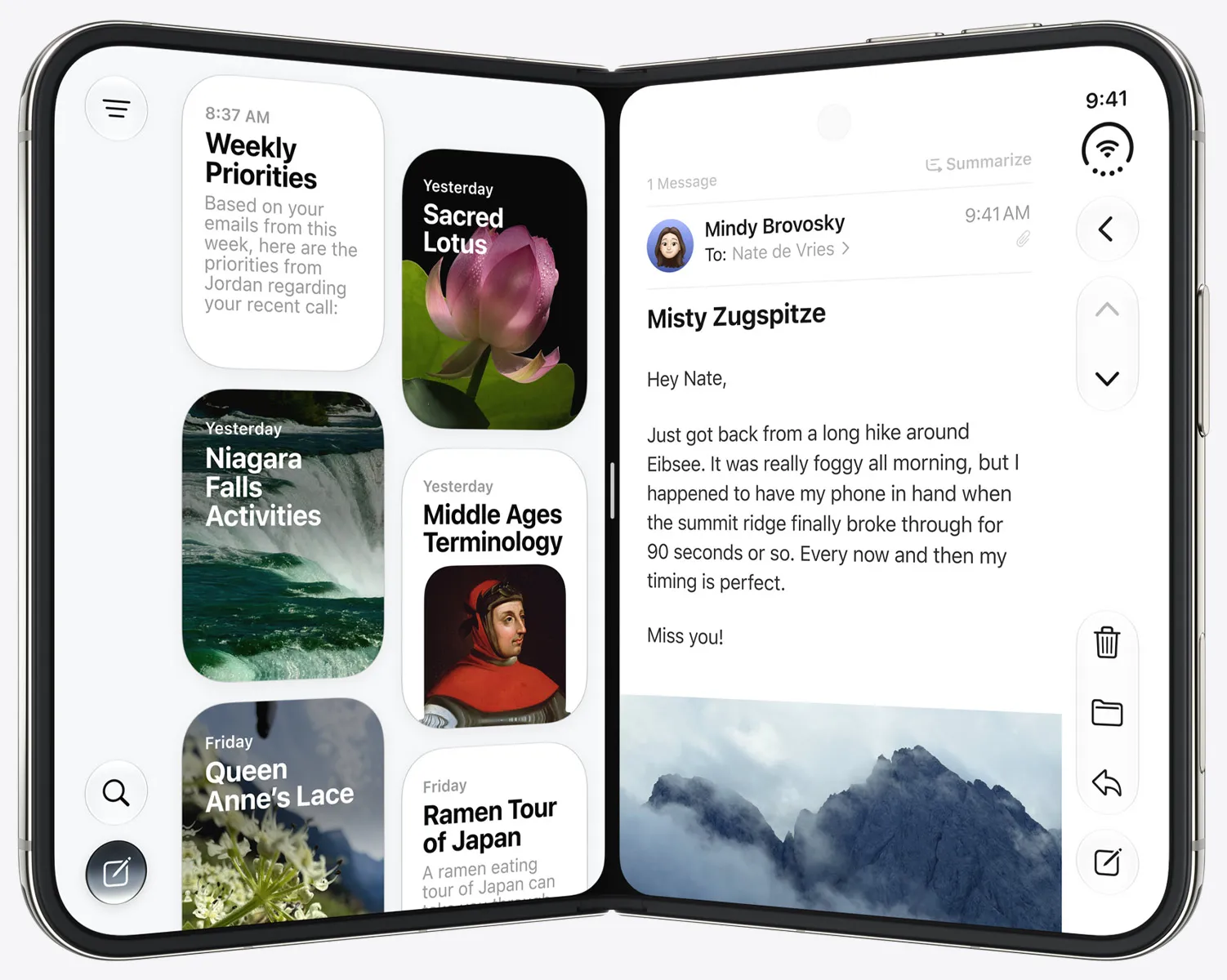
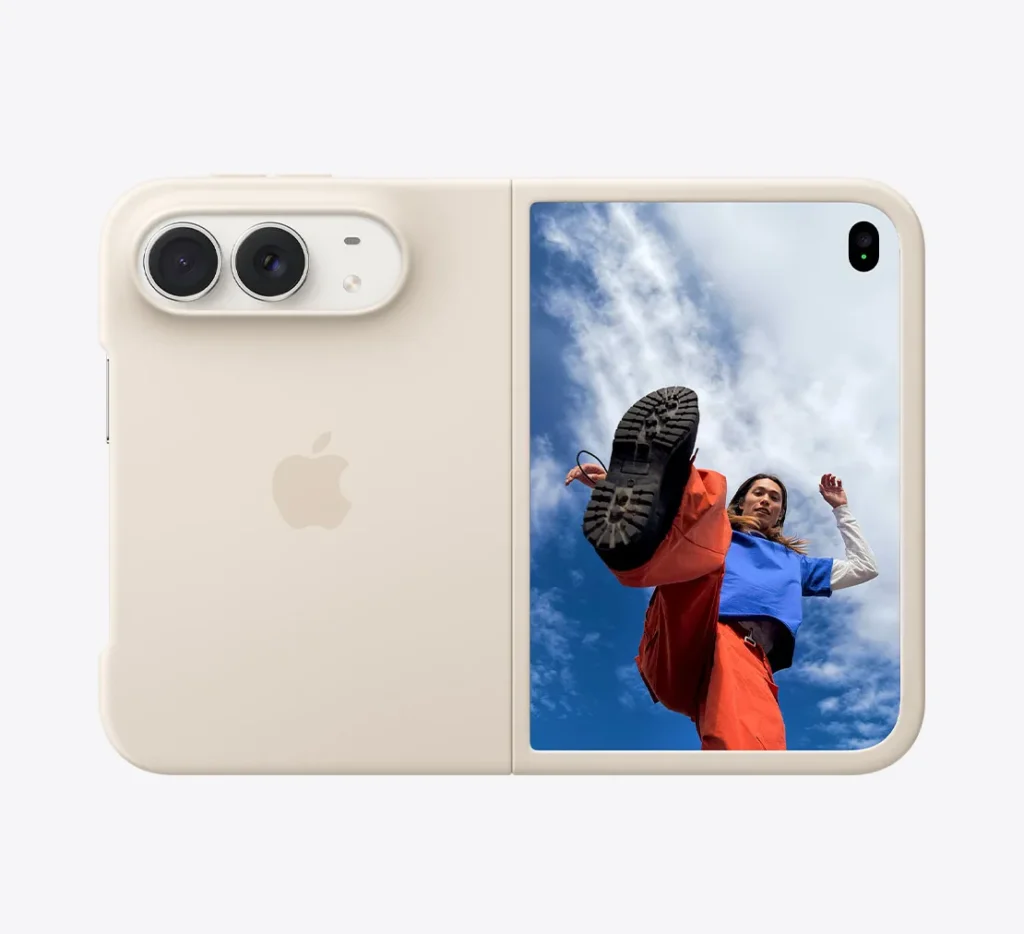
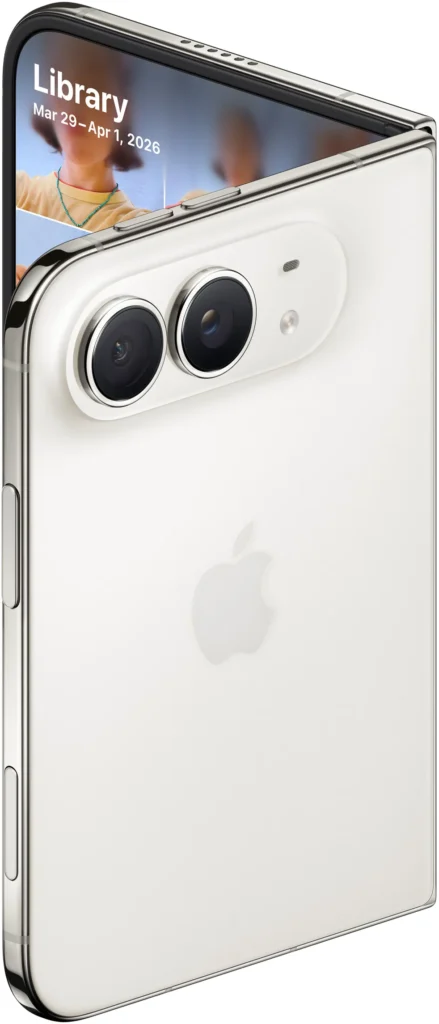
The Apple iPhone Duo uses a book-style design. Closed, there is a 5.4-inch outer Super Retina XDR OLED display. Open it and you get a 7.6-inch 1878 × 2670 folding OLED panel with ProMotion up to 120Hz, Always-On support and a quoted peak outdoor brightness of 3,000 nits. (Apple)
That sounds like a specification sheet until you look at the dimensions. Closed, the phone measures 84.1 mm wide, 117.8 mm tall and 11.3 mm thick. Opened, it becomes only 5.2 mm thick and 164.6 mm wide. (Apple)
The big change is not that Apple made an iPhone screen slightly larger. It made an iPhone that can switch between a compact phone and a small tablet without asking you to carry two devices.
The Duo weighs 254 grams. Surprisingly, that is only five grams heavier than the 249-gram iPhone 18 Pro Max, although its shorter and much wider folded shape should feel very different in a pocket. (Apple)
| Specification | iPhone Duo |
|---|---|
| Starting price | $1,999 in the U.S. |
| Outer display | 5.4-inch OLED, up to 120Hz |
| Inner display | 7.6-inch folding OLED, up to 120Hz |
| Processor | A20 Pro |
| Storage | 256GB, 512GB, 1TB, 2TB |
| Weight | 254g |
| Rear cameras | 48MP main + 48MP ultrawide |
| Authentication | Side-button Touch ID |
| Water/dust rating | IP68 |
| Software | iOS 27.1 at launch |
| U.S. availability | October 23, 2026 |
Apple also uses grade 5 titanium, Ceramic Shield protection and a hinge made from more than 100 components. The Duo carries an IP68 rating, with Apple specifying laboratory testing at up to six metres of water for 30 minutes. (Apple)
The 7.6-inch screen matters because you can actually use the space
Plenty of phones have become larger without becoming much better at displaying information. The iPhone Duo takes a different route because iOS 27 can treat the opened phone as two usable areas rather than one oversized version of a normal iPhone app.
Apple has added Split View to iPhone for the first time. Two apps can sit next to each other, you can open two windows from the same app such as Safari, swap either side without closing the other app and save app pairs for later. (Apple)
That is the strongest reason to buy the Duo: the inner display can remove the constant app switching that normally makes serious work on a phone annoying.
There are some very ordinary situations where that becomes useful:
- Keep Maps open while Messages stays visible beside it during a trip.
- Compare two products in separate Safari windows instead of jumping between tabs.
- Watch a video while answering messages or checking related information.
- Join a Zoom call while keeping the shared document visible beside the participants.
- Keep email open beside Calendar while deciding where a new meeting fits.
- Talk to Siri while leaving the page or document you are asking about on screen.
Apple says apps such as Netflix, Zoom and Slack are already adapting their interfaces for the folding design. Zoom, for example, can use the larger display to keep shared content and meeting participants visible together. (Apple)
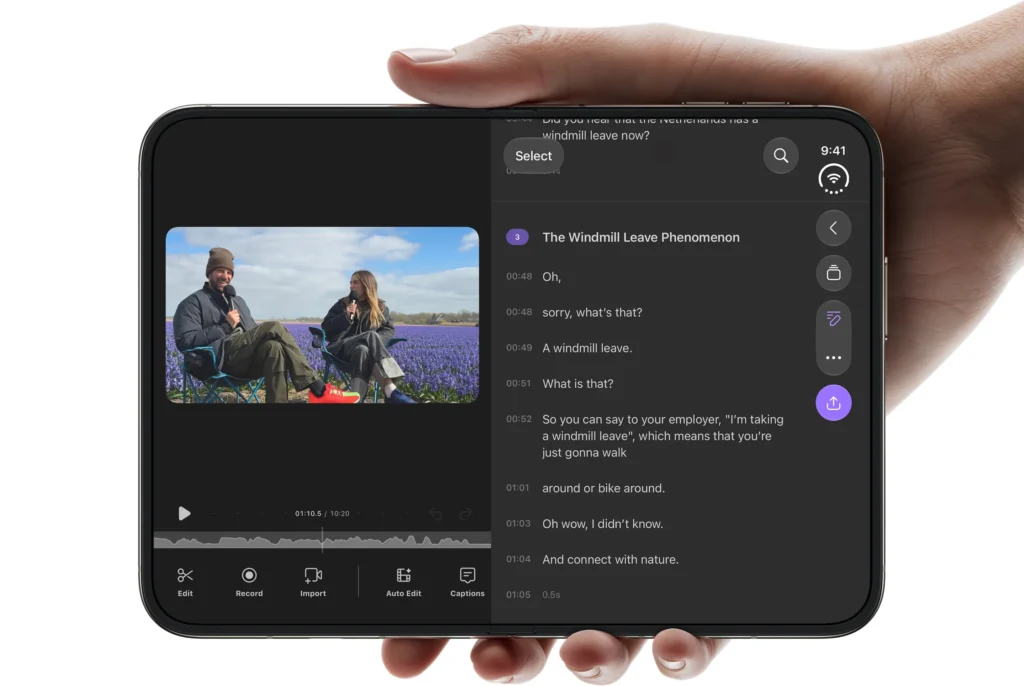
(Image: iPhone Duo running Maps and Messages side by side on the 7.6-inch display)
This is also where Apple’s software work matters more than the hinge itself. iOS 27 moves interface elements to the side where appropriate, changes the Dynamic Island layout and lets content respond as the phone opens, rotates or moves between displays. (Apple)
For more on where Apple’s software is heading, see our coverage of Apple WWDC 2026 and our breakdown of Apple AI in 2026.
Folding the phone creates advantages that have nothing to do with multitasking
The camera is a good example. The iPhone Duo has a 48MP Fusion main camera and a 48MP Fusion ultrawide, with the main sensor also providing an optical-quality 2x crop. There is no dedicated long telephoto camera like the one found on Apple’s Pro models. (Apple)
That sounds like an obvious downgrade until the second display gets involved.
You can use the main rear cameras for a selfie while seeing yourself on the outer display. Duo Preview can show the person being photographed exactly how the shot is framed, and Apple has even added Kid Cue, which plays animations on the outer screen to encourage children to look toward the camera. (Apple)
A second display is much more useful when Apple treats it as part of the camera system instead of leaving it dark whenever the phone is open.
The folding chassis can also sit partially open on a table. That gives you a built-in stand for FaceTime, time-lapse recording or group photos without balancing the phone against a coffee mug.
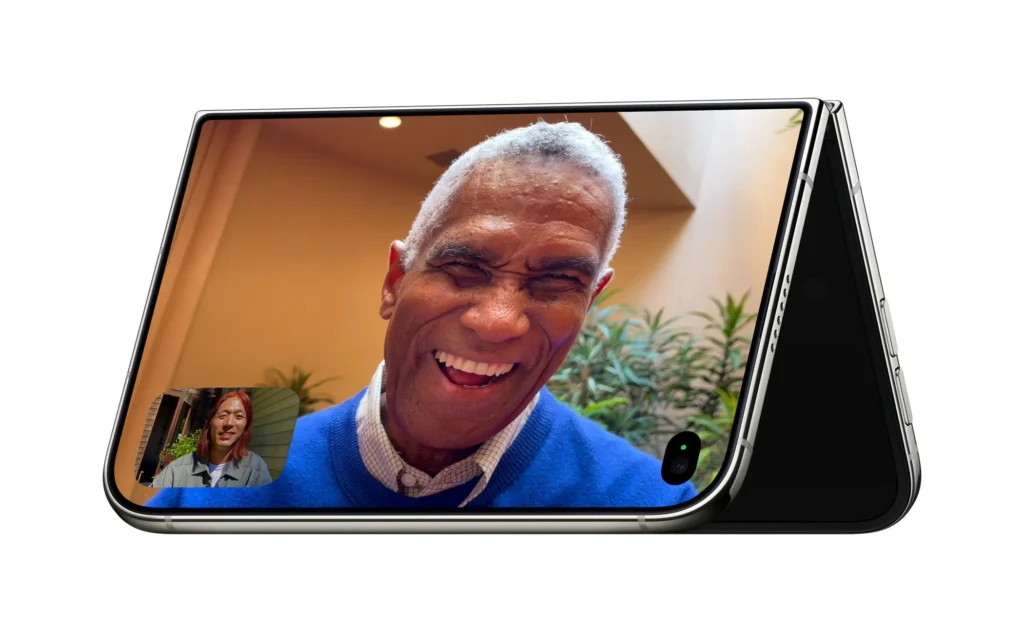
(Image: iPhone Duo half-folded for photography with the outer display showing a live preview)
Video specifications remain serious. The main camera supports 4K recording at up to 120 fps in Dolby Vision, while the folding position can hold the phone in place for longer static recordings. (Apple)
You give up more than $1,999
This is still a first-generation Apple foldable. The iPhone Duo specs include some compromises that buyers of Apple’s most expensive conventional phone will notice immediately.
The biggest one is Face ID.
Apple moved biometric authentication to a Touch ID sensor built into the side button. It works while the phone is open or closed, and Apple Watch unlocking is supported, but anyone used to glancing at an iPhone to authenticate will have to retrain a familiar habit. (Apple)
The Duo is Apple’s most expensive iPhone, but it is not Apple’s best iPhone in every category.
The camera system makes that especially clear. The iPhone 18 Pro Max is positioned as Apple’s camera flagship with a 48MP variable-aperture main camera and more advanced Pro camera controls, while the Duo focuses more heavily on the possibilities created by folding and having two displays. (Apple)
Battery life is another trade-off. Apple rates the Duo for up to 24 hours of typical mixed use, up to 31 hours of video playback on the inner display and up to 44 hours if playback stays on the outer display. The 18 Pro Max is rated for up to 30 hours of typical use and 45 hours of video playback. (Apple)
The difference becomes larger for streamed video on the big folding display. Apple lists up to 26 hours for the Duo’s inner screen versus up to 38 hours for streamed playback on the iPhone 18 Pro Max. (Apple)
Then there is the inner display itself. Apple has added a nano-texture finish, scratch-resistant coating, high-strength glass layers and a titanium support plate beneath the panel, but folding displays remain mechanically more complicated than a single rigid sheet of glass. (Apple)
Long-term crease visibility, hinge wear and the way that inner surface looks after a year of real pockets, dust and fingerprints are exactly the details that cannot be judged properly a few days after an announcement.
iPhone Duo vs iPhone 18 Pro Max: where does the extra $700 go?
The iPhone Duo price starts at $1,999 for 256GB. The iPhone 18 Pro Max starts at $1,299 with the same base storage, leaving a substantial $700 gap before accessories or AppleCare enter the picture. (Apple)
Here is the practical iPhone Duo vs iPhone 18 Pro Max comparison.
| iPhone Duo | iPhone 18 Pro Max | |
|---|---|---|
| Starting price | $1,999 | $1,299 |
| Main display | 7.6-inch folding OLED | 6.9-inch OLED |
| Secondary display | 5.4-inch OLED | None |
| Weight | 254g | 249g |
| Chip | A20 Pro | A20 Pro |
| Authentication | Touch ID | Face ID |
| Multitasking | Two apps in Split View | Standard iPhone app switching |
| Apple Pencil | USB-C Pencil support planned | No |
| Main appeal | Folding screen and dual-screen uses | Camera, battery and conventional design |
Both use Apple’s A20 Pro processor, so the Duo is not charging $700 extra for a faster CPU. You are paying almost entirely for the folding hardware, second display and the software experiences that become possible because those two things exist. (Apple)
(Image: iPhone Duo unfolded beside the iPhone 18 Pro Max to show the difference in usable screen space)
That distinction makes the buying decision easier. If you mainly want the best conventional iPhone with a strong camera and long battery life, the Pro Max is the more rational purchase.
If you constantly work between two apps, read long documents, compare webpages, watch video away from a tablet or frequently wish an iPhone could turn into a larger screen, the Duo has something the Pro Max simply cannot reproduce.
Apple is entering a foldable category that is already mature
Apple is late. Samsung’s original Galaxy Fold arrived in 2019, and by the time the Duo reaches stores Apple will be competing with devices such as the Galaxy Z Fold8 and Google’s Pixel 11 Pro Fold. Reuters puts Samsung’s 2026 Galaxy Z Fold8 starting price at $1,899, while Google also lists the Pixel 11 Pro Fold at $1,899 before trade-in offers. (Reuters)
That puts the Duo only $100 above two major Android alternatives rather than hundreds of dollars above the whole category.
Samsung’s Galaxy Z Fold8 is especially interesting because its dimensions target almost the same idea. It has a 5.5-inch cover display and 7.6-inch inner display, yet Samsung lists the Fold8 at just 201 grams, making it dramatically lighter than Apple’s 254-gram Duo. (Samsung pl)
Apple does not win the foldable comparison simply by arriving with an Apple logo. Samsung already has eight generations of experience and is offering a much lighter device for less money.
The Duo fights back with an IP68 rating, while Samsung lists IP48 protection for the Fold8. Apple’s inner screen also supports the USB-C Apple Pencil, with support scheduled for later in 2026, whereas Samsung’s regular Fold8 does not support an S Pen. (Apple)
Google’s Pixel 11 Pro Fold goes larger with an 8-inch inner display and 6.5-inch cover screen. It also reaches IP68, starts at $1,899 and leans heavily on Google’s Android 17 software and AI features. (Google Store)
(Image: iPhone Duo between the Galaxy Z Fold8 and another large Android foldable)
The difference may eventually come down to apps. Apple has been able to design iOS 27, its first-party apps and the Duo hardware at the same time, but established Android foldables have had years to build multitasking habits and developer support.
That is something to watch after launch rather than something that can be settled from a presentation.
The iPhone Duo release date is later than the iPhone 18 Pro Max
One detail could easily get lost among the launch headlines: the iPhone Duo was announced on September 9, but it is not in stores yet.
The iPhone Duo release date is October 23, 2026. Apple opens pre-orders on Friday, October 16, with the first wave covering more than 70 countries and regions. (Apple)
The phone comes in Night Sky and Star White, with four storage options:
- 256GB
- 512GB
- 1TB
- 2TB
The U.S. starting price is $1,999. Apple has not forced buyers into 512GB just because this is a premium folding model, although anyone storing large 4K video files may quickly find 256GB restrictive. (Apple)
Apple also sells a $79 Duo Case and a $129 Duo Folio with an integrated kickstand. MagSafe and Qi2 wireless charging reach up to 25W, while wired fast charging can take the battery to roughly 50 percent in around 20 minutes with the required 60W-capable adapter. (Apple)
Our iPhone Duo review verdict has to wait for one thing
Search for an iPhone Duo review right now and there is a problem: retail units do not arrive until October 23.
A launch demo can tell you whether the hinge feels good. It cannot tell you what the inner screen looks like after 5,000 folds, whether third-party apps repeatedly open in awkward layouts, or how the dual batteries perform after several weeks of mixed inner-screen and outer-screen use.
The responsible early verdict is that the Duo’s concept makes sense, but its $1,999 value cannot be fully judged until the folding hardware has lived in real pockets for a while.
The signs are promising. Apple has avoided simply stretching standard iOS across a tablet-shaped display, Split View gives the big screen an obvious reason to exist, and features such as Duo Preview make clever use of the second display. (Apple)
A20 Pro also gives the Duo the same processor family as the iPhone 18 Pro models, paired with a custom vapor chamber and dual batteries. Performance should not be the reason to avoid it. (Apple)
The questions sit elsewhere: durability, battery behavior under heavy inner-screen use, app compatibility and whether the novelty of opening the phone still feels useful six months later.
The buying decision: who should pay $1,999?
There is a simple way to think about the iPhone Duo.
Do not buy it because it folds.
Buy it if folding solves something you regularly dislike about a normal smartphone. If you often want Maps beside Messages, two Safari pages at once, a proper document beside your email or a larger screen for flights and trains without bringing an iPad, the Duo can change how you use an iPhone every day.
For that kind of user, the 7.6-inch display is the product. The hinge is just how Apple gets it into your pocket.
For everyone else, the iPhone 18 Pro Max is hard to ignore. It costs $700 less, uses the same A20 Pro chip, offers Face ID, has Apple’s more ambitious Pro camera system and carries a stronger battery rating for heavy use. (Apple)
The established Android foldables make the decision harder again. Samsung’s Galaxy Z Fold8 starts $100 below the Duo and weighs 53 grams less, while Google’s Pixel 11 Pro Fold gives you an even larger 8-inch internal display at the same $1,899 starting point. (Reuters)
Apple’s first foldable iPhone therefore does not win automatically on price, weight or camera hardware. What makes the iPhone Duo interesting is that Apple has finally given iPhone users a practical reason to open their phone and leave it open.
If those split-screen moments already sound useful before you own one, the Duo deserves a serious look on October 23. If you are still trying to invent reasons to need the second screen, keep the $700.
Frequently Asked Questions
Is the iPhone Duo actually a foldable iPhone?
Yes. The iPhone Duo is Apple’s first book-style foldable iPhone, with a 5.4-inch exterior display and a 7.6-inch folding OLED display inside. Apple officially announced it on September 9, 2026. (Apple)
How much does the iPhone Duo cost?
The iPhone Duo price starts at $1,999 in the U.S. with 256GB of storage. Apple also offers 512GB, 1TB and 2TB configurations. (Apple)
When is the iPhone Duo release date?
Pre-orders begin on October 16, 2026, and general availability starts on October 23, 2026 in the first group of markets. Apple says another 28 countries and regions will follow on October 30. (Apple)
Does the iPhone Duo have Face ID?
No. Apple uses Touch ID in the side button instead of Face ID on the iPhone Duo. The phone can also be unlocked with a compatible Apple Watch. (Apple)
Is the iPhone Duo better than the iPhone 18 Pro Max?
The Duo is better for split-screen multitasking, reading and situations where the 7.6-inch folding display replaces the need for a small tablet. The iPhone 18 Pro Max is $700 cheaper at its U.S. starting price and is the stronger choice for buyers prioritizing conventional camera hardware, Face ID and battery life. (Apple)
Want the next iPhone Duo tests, software changes and Apple news without checking twenty different sites? Follow the latest stories with the Tech Feed app and keep an eye on Tech-Play as the Duo reaches real users on October 23.
Apple, iPhone and related Apple product names are trademarks of Apple Inc. Tech-Play is an independent publication and is not affiliated with, sponsored by, or endorsed by Apple Inc. Product images are credited to their respective copyright owners.