The heat wave technology impact is no longer just about uncomfortable rooms, hot pavements, and higher electricity bills. Extreme heat now reaches deep into the digital systems we depend on every day, from cloud servers and AI platforms to smartphones, laptops, smart homes, and city infrastructure.
When temperatures rise, technology does not simply “keep running.” It adapts, slows down, consumes more energy, and sometimes fails exactly when people need it most.
The heat wave technology impact starts with invisible heat
Heat waves are often described as weather events, but they are also stress tests for modern technology. Every connected device creates heat, every server rack must remove heat, and every battery performs best within a safe temperature range.
The most important shift is this: heat is becoming a technology performance problem, not just a comfort problem.
A smartphone in direct sunlight, a laptop rendering video in a warm room, a gaming console inside a closed TV cabinet, or a data center running AI workloads during a heat wave all face the same basic challenge. Electronics need stable thermal conditions to deliver reliable performance.
That matters because our digital life is now always-on. Payments, maps, emergency alerts, streaming, smart locks, delivery apps, hospital systems, and cloud platforms all depend on hardware that must stay cool enough to work.
WMO has warned that extreme heat events are increasingly tied to early warning systems and heat-health action plans, especially as cities face hot days and warm nights that reduce recovery time. This makes technology resilience part of public resilience too.
Data center cooling is becoming a core internet issue
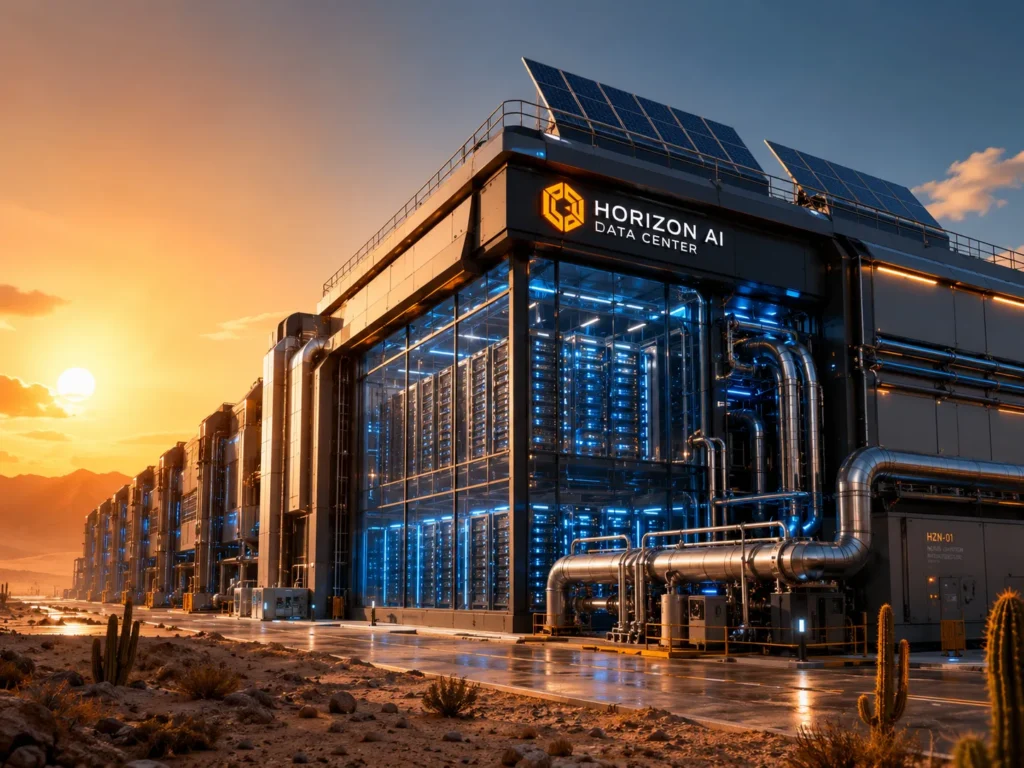
Behind every app, video, website, AI chatbot, and cloud backup is a data center. These buildings are filled with servers that generate constant heat, and removing that heat is one of the biggest operational challenges in modern computing.
Data center cooling is no longer a background utility; it is now a strategic part of digital infrastructure.
The International Energy Agency projects that global data center electricity consumption could roughly double by 2030, reaching around 945 TWh in its base case. That growth is strongly connected to cloud computing, AI, and the rising demand for high-performance chips.
The problem is simple to understand. More compute means more power, more power means more heat, and more heat means more cooling.
Traditional air cooling still works for many facilities, but the most demanding AI and high-performance computing systems are pushing operators toward advanced solutions such as:
- Direct-to-chip liquid cooling
- Immersion cooling
- Smarter airflow design
- Heat reuse systems
- AI-controlled HVAC optimization
- Better site selection based on climate and grid capacity
During a heat wave, cooling systems must work harder because the outside air is warmer. If the grid is also under pressure from air-conditioning demand, data centers may face higher energy prices, tighter operating limits, or more scrutiny from local communities.
This is why the conversation around AI infrastructure is expanding beyond chips and models. It now includes energy, water, cooling, heat rejection, grid planning, and climate resilience.
In some locations, water use is becoming just as sensitive as electricity use. Evaporative cooling can reduce electricity demand, but it can increase water demand, which becomes controversial during drought or extreme heat.
The future of data center cooling will likely be hybrid. Some facilities will use liquid cooling for dense AI racks, air cooling for standard workloads, and software that shifts compute tasks based on energy availability, local temperature, and cooling capacity.
Smartphones and laptops slow down when heat rises
Most people notice heat wave technology impact first through their own devices. A phone gets hot in the car. A laptop fan becomes loud. A tablet dims its screen. A camera stops recording. A gaming handheld drops frame rates.
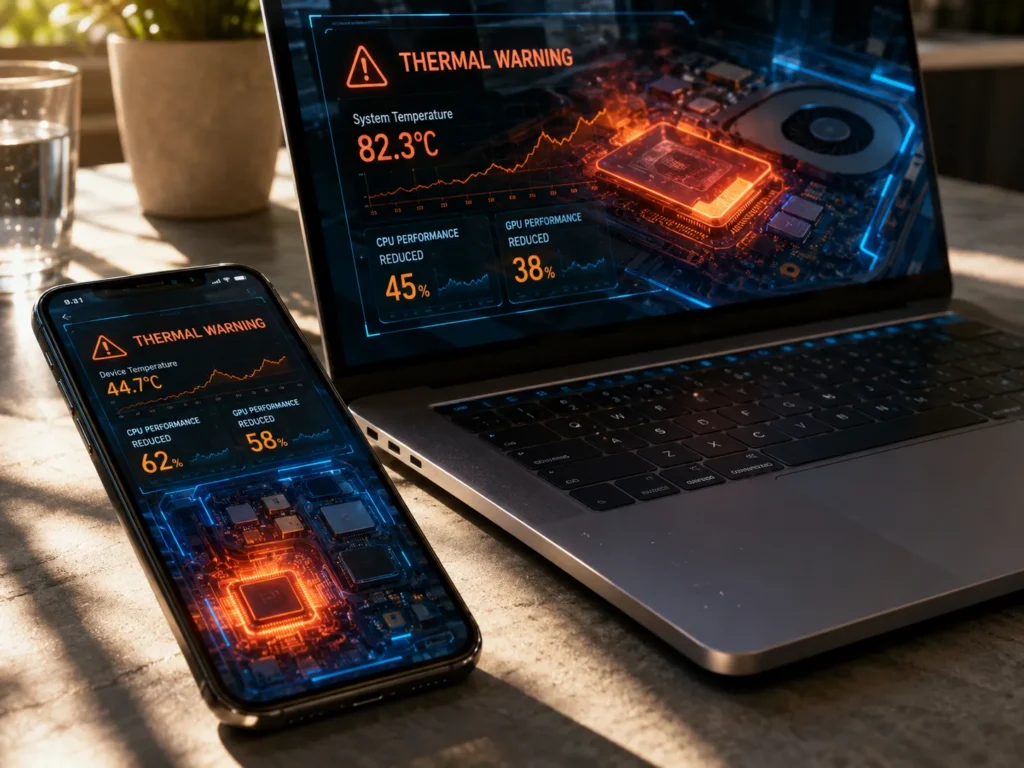
When devices get too hot, they protect themselves by reducing performance before permanent damage happens.
This behavior is often called CPU thermal throttling. Intel explains throttling as a processor mechanism that reduces clock speed when temperature rises above the safe thermal limit, helping protect the processor and signal an overheating issue.
The same general idea applies across modern consumer electronics. Chips are designed to boost performance when thermal conditions allow it and pull back when heat becomes unsafe.
Apple says iPhone and iPad devices are designed for use in ambient temperatures between 0°C and 35°C. High or low temperature conditions can cause behavior changes because the device needs to regulate itself.
That explains why a phone can feel “slower” on a hot day. It may reduce screen brightness, slow charging, limit camera features, pause certain tasks, or show a temperature warning.
For users, this can be annoying. For creators, drivers, travelers, outdoor workers, and emergency responders, it can become a real problem.
Heat affects everyday devices in several ways:
- Performance drops: CPUs and GPUs reduce speed to stay safe.
- Battery stress increases: Lithium-ion batteries dislike extreme temperatures.
- Charging slows: Devices may limit charging to avoid overheating.
- Screens dim: Bright displays generate heat and consume more power.
- Cameras can stop: 4K video recording creates heavy thermal load.
- Network performance may suffer: Hot devices can reduce radio activity or background tasks.
This is why summer device care matters. Avoid leaving phones in parked cars, keep laptops off blankets, remove thick cases during heavy charging, and keep gaming consoles or routers in ventilated spaces.
A small habit can save performance. It can also extend device life.
Heat waves expose the hidden limits of smart homes
Smart homes promise comfort, automation, and efficiency. During a heat wave, they also become part of the climate response.
Smart thermostats, connected blinds, air quality sensors, smart plugs, and smart cooling devices can help reduce energy waste while keeping homes livable. But they also depend on electricity, Wi-Fi, cloud services, and stable indoor conditions.
The best smart home setup is not just automated; it is heat-aware.
A smart thermostat can pre-cool a home before peak electricity hours. Smart blinds can close before direct sun hits the room. Smart plugs can shut off unnecessary standby devices that generate extra heat. Air quality sensors can help decide when to ventilate and when to keep windows closed.
Smart cooling devices are becoming more interesting because people want targeted comfort without cooling the entire home. Portable AC units, smart fans, evaporative coolers, heat pump systems, and room-based sensors can all play a role.
The key is coordination. Cooling one room intelligently can be more efficient than forcing the whole house to a low temperature all day.
A heat-aware smart home can use routines like:
- Close blinds automatically when outdoor temperature rises.
- Pre-cool rooms before peak electricity demand.
- Turn off unused electronics that add heat indoors.
- Run fans when they improve perceived comfort.
- Monitor indoor humidity, not just temperature.
- Send alerts when children, pets, or older family members may be at risk.
This is where climate tech becomes personal. It is not only about big infrastructure or future inventions. It is about small systems that make daily life safer and more efficient during hotter summers.
Heat wave forecasting AI is changing how we prepare
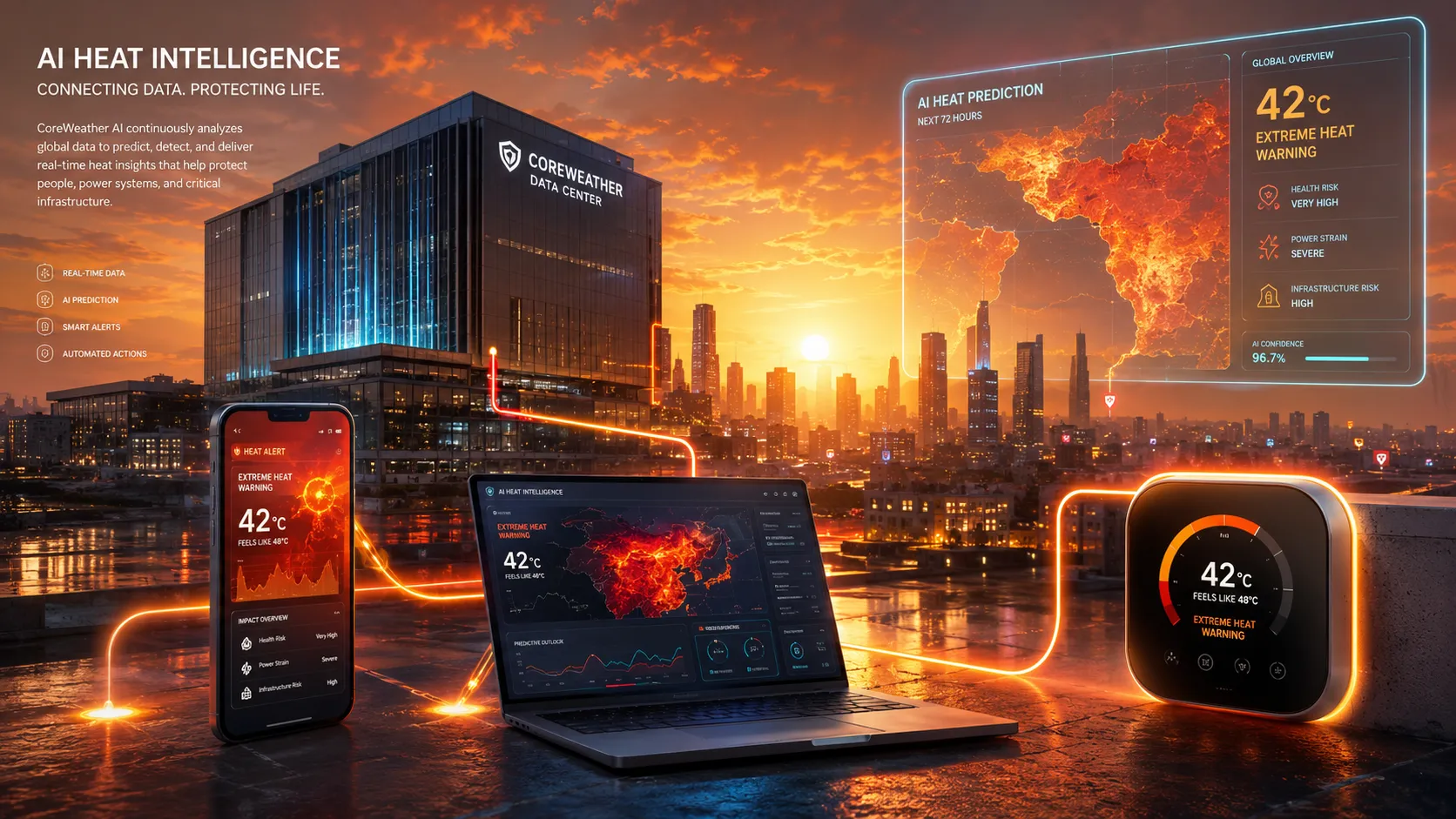
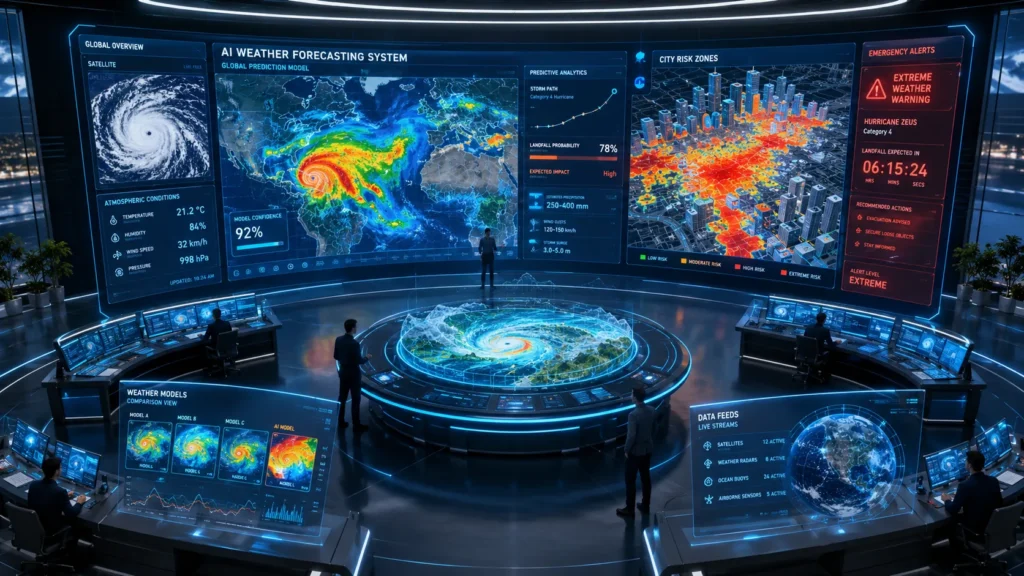
Forecasting heat used to be mostly about temperature maps and weather reports. Today, heat wave forecasting AI can combine satellite observations, historical climate data, local geography, humidity, wind, soil moisture, and urban heat patterns to generate more useful risk predictions.
AI forecasting is powerful because it can turn weather data into earlier, more targeted decisions.
NOAA launched operational AI-driven global weather prediction models in 2025, describing them as faster and more efficient tools that can support forecasters with improved guidance while using fewer computing resources.
WMO has also emphasized that AI can accelerate early warnings, while complementing rather than replacing traditional forecasting systems. That balance matters because extreme weather decisions still require expert interpretation, local knowledge, and trust.
AI weather models are not magic. Some research suggests they are improving quickly, while other studies warn that record-breaking extremes remain difficult for AI systems to predict reliably. This is important because the most dangerous heat waves are often the unusual ones.
Still, the direction is clear. Forecasting is becoming faster, more localized, and more connected to action.
A city could use AI-supported heat forecasts to:
- Open cooling centers earlier
- Adjust public transport plans
- Warn hospitals about expected demand
- Protect outdoor workers
- Optimize electricity grid operations
- Target alerts to the hottest neighborhoods
- Schedule maintenance before equipment fails
For consumers, the same concept can appear in apps and smart home systems. Your phone could warn you that tomorrow’s heat may affect outdoor exercise, battery performance, air quality, and home cooling costs.
Climate tech is moving from optional to essential
Climate tech often sounds like a future-focused investment category, but heat waves make it immediate. The need is not only cleaner energy. It is also better adaptation.
Climate tech is becoming the practical toolkit for living, working, and computing in hotter conditions.
This includes technologies that reduce emissions, but also technologies that help society handle the heat already arriving. Better batteries, efficient heat pumps, smart grids, reflective materials, cool roofs, advanced insulation, thermal cameras, sensor networks, and AI forecasting all belong in the picture.
In cities, climate tech can help identify urban heat islands. Asphalt, concrete, dense traffic, and limited shade can make some neighborhoods much hotter than others.
In homes, climate tech can reduce energy waste while improving comfort. A heat pump, smart thermostat, and proper shading can be more powerful together than any single gadget alone.
In industry, climate tech can protect productivity. Factories, warehouses, logistics centers, agriculture, and construction all need better heat monitoring and worker safety systems.
In computing, climate tech can help data centers use cleaner electricity, reduce water pressure, reuse waste heat, and run workloads more intelligently.
The exciting part is that the same digital tools creating new heat challenges can also help solve them. AI stresses data centers, but AI can also optimize cooling. Smartphones struggle in hot weather, but they can also deliver life-saving alerts. Smart homes consume power, but they can also reduce peak demand.
That tension defines the next phase of technology.
The grid is the quiet hero of heat resilience
A heat wave puts pressure on everything at once. People turn on air conditioners, businesses increase cooling, EV owners still need charging, and data centers continue running.
The power grid becomes the foundation that decides whether digital life stays stable during extreme heat.
If electricity demand spikes faster than supply, utilities may need demand response programs, battery storage, backup generation, or temporary load reductions. In severe cases, outages can turn a heat wave from uncomfortable to dangerous.
This is why smart grids matter. A smarter grid can forecast demand, shift loads, integrate renewables, use battery storage, and reward consumers for reducing usage during peak hours.
Data centers may also become more flexible. Some workloads do not need to run in a specific location at a specific minute. In theory, non-urgent compute jobs could move to cooler regions or times when renewable electricity is more available.
That idea is still complex, especially for AI workloads that require expensive GPUs and low-latency access. But as heat waves become more frequent, flexibility will become more valuable.
The next generation of digital infrastructure will not only ask, “How fast can we compute?” It will also ask, “Can we compute reliably when the grid, climate, and cooling systems are under stress?”
What users can do to protect their tech during heat waves
You do not need to run a data center to care about heat resilience. A few simple habits can protect your devices and reduce frustration.
The easiest win is to keep devices cool before they become hot enough to throttle.
For phones and tablets:
- Keep them out of direct sunlight.
- Do not leave them in parked cars.
- Remove thick cases during heavy charging.
- Avoid gaming or video editing while charging in hot rooms.
- Use lower screen brightness when outside.
- Let the device cool naturally instead of putting it in a fridge.
For laptops and PCs:
- Keep vents clear.
- Use hard surfaces instead of beds or blankets.
- Clean dust from fans and filters.
- Avoid heavy workloads in very hot rooms.
- Improve room airflow.
- Monitor temperatures during gaming, rendering, or AI work.
For routers, consoles, and smart home hubs:
- Keep them in open spaces.
- Avoid closed cabinets.
- Do not stack hot devices.
- Check power adapters for excess heat.
- Restart devices only after they have cooled if they become unstable.
For smart homes:
- Use schedules to pre-cool rooms.
- Close blinds before peak sun.
- Track humidity as well as temperature.
- Use fans to improve comfort at higher thermostat settings.
- Set alerts for indoor temperature thresholds.
These steps sound basic, but they work because heat problems often build slowly. Prevention is easier than recovery.

Why businesses should treat heat as a technology risk
Companies often plan for cybersecurity, backups, and software outages. Heat risk deserves the same level of attention.
Every business that depends on devices, cloud tools, payments, logistics, or connected equipment has a heat exposure.
A restaurant can lose point-of-sale systems during an outage. A delivery company can face battery and navigation problems. A small office can lose productivity when laptops throttle. A factory can see sensors, controllers, or network equipment become unstable. A website can suffer if upstream infrastructure is strained.
The practical move is to map heat-critical systems before summer peaks. Businesses should know which devices must stay online, which rooms overheat, which cloud services are critical, and which backup options exist.
A simple heat resilience checklist can include:
- Identify the hottest rooms and equipment zones.
- Keep networking gear ventilated.
- Test backup internet and power options.
- Review cloud provider reliability and region choices.
- Prepare remote-work plans for overheated offices.
- Protect outdoor workers and field devices.
- Schedule heavy compute tasks outside peak heat when possible.
- Communicate clearly with customers during disruptions.
This is not fear-based planning. It is professional risk management.
As heat waves become more intense, technology teams, facility managers, and business owners will need to work together more closely.
Frequently Asked Questions
How do heat waves affect technology?
Heat waves affect technology by making devices and infrastructure work harder to stay within safe operating temperatures. Phones, laptops, routers, servers, and batteries can slow down, overheat, or shut off when cooling is not enough.
Why do phones slow down during hot weather?
Phones slow down because their processors and batteries need protection from excessive heat. The device may reduce performance, dim the screen, slow charging, or pause features to avoid damage.
What is CPU thermal throttling?
CPU thermal throttling is when a processor reduces its speed because it is getting too hot. This protects the chip, but it can also make laptops, phones, gaming PCs, and servers feel slower.
Why is data center cooling important during heat waves?
Data center cooling is important because servers generate huge amounts of heat while running cloud apps, websites, AI tools, and online services. During heat waves, cooling systems must work harder, which can increase energy use and stress local infrastructure.
Can AI help predict heat waves?
Yes, AI can support heat wave forecasting by analyzing large amounts of weather, climate, and satellite data quickly. However, AI forecasts still need expert oversight, especially for rare or record-breaking extremes.
Conclusion: heat is now part of the tech conversation
The heat wave technology impact is one of the clearest examples of how climate, energy, hardware, software, and daily life now connect. Extreme heat can slow phones, strain data centers, pressure power grids, and push smart homes to become smarter.
But this is not only a problem. It is also an innovation trigger.
Better cooling, smarter forecasts, more efficient chips, resilient grids, and practical climate tech can help the digital world stay reliable as summers get hotter. The winners will be the companies, cities, and users who treat heat as a real technology challenge before it becomes an emergency.
Want more future-ready tech guides? Visit tech-play.net for smart explainers on AI, apps, climate tech, and the digital tools shaping everyday life.