AI technology World Cup 2026: 7 Game-Changers
The World Cup has always been about pressure, drama, and impossible split-second moments. But in 2026, the most important player on the pitch might not wear boots at all: it is data.
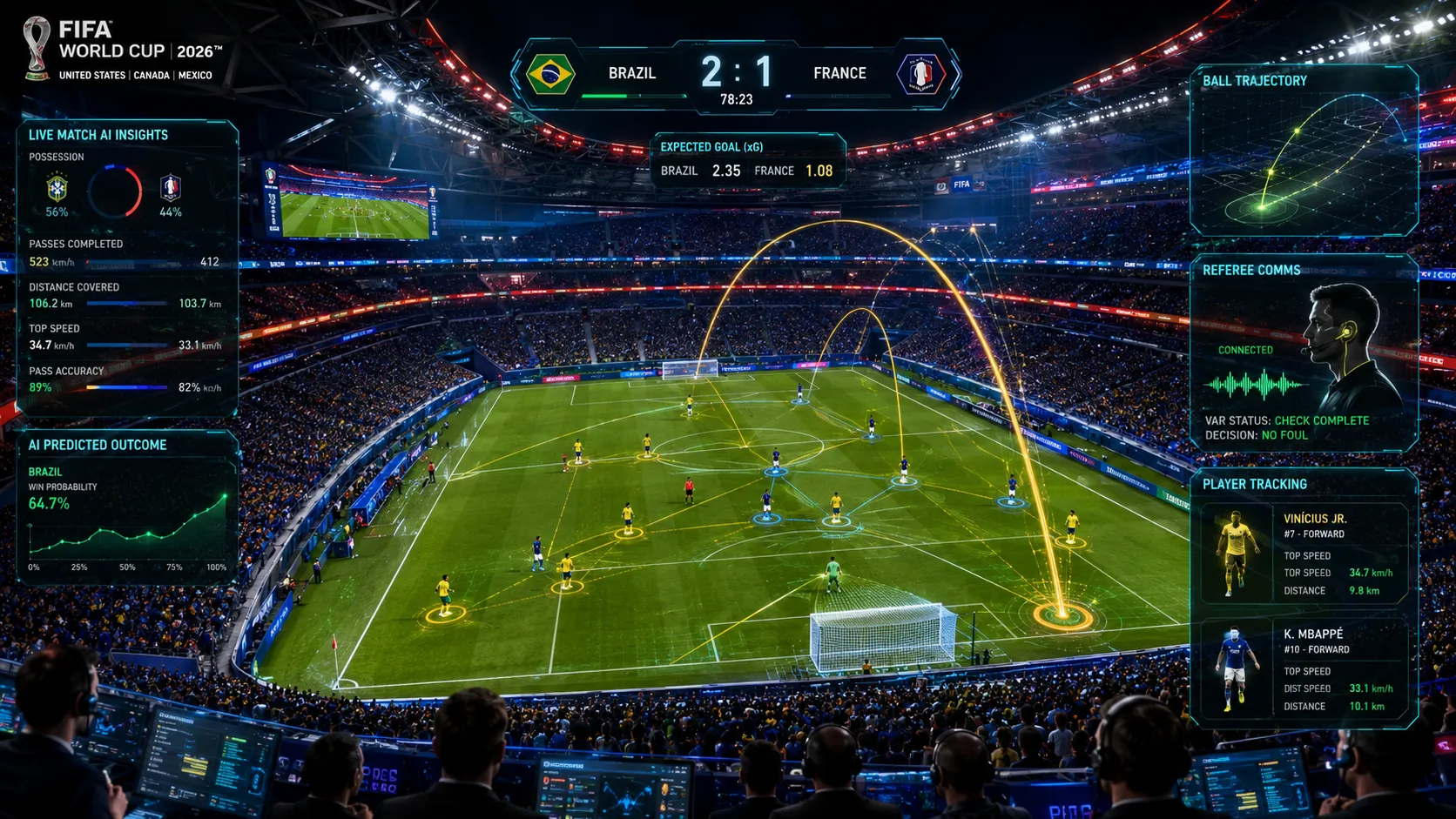
AI technology World Cup 2026 is changing how goals are checked, offsides are judged, coaches prepare, fans watch, and players respond under pressure. The tournament in Canada, Mexico, and the United States is not just the biggest World Cup ever; it is football’s most advanced live technology experiment. FIFA has confirmed that the 2026 tournament runs from June 11 to July 19 and includes major innovations across officiating, team analysis, fan experience, and match operations.
Why AI technology World Cup 2026 Matters
World Cup games are often decided by centimeters, seconds, or one tactical mistake. A striker leans too early. A ball crosses the line by a fraction. A defender blocks the goalkeeper’s view. A coach spots a weak pressing pattern one minute before the opponent scores.
That is why World Cup 2026 innovations matter so much. They are not just cool gadgets for broadcast graphics. They are becoming part of the competitive environment itself.
FIFA has said the tournament will use advanced semi-automated offside technology, connected ball technology, goal-line technology, Referee View, Football AI Pro, and optical tracking systems. It also confirmed that all 48 teams will get access to advanced match-analysis capabilities, not only the richest football federations.
That means AI is not replacing football. It is compressing the time between action, evidence, decision, and reaction.
1. Advanced FIFA Semi-Automated Offside Technology
Offside is where technology can change the emotional rhythm of a match. In older VAR moments, fans waited, players stood around, and stadium energy froze while officials checked lines. In 2026, FIFA semi-automated offside technology gets faster and more direct.
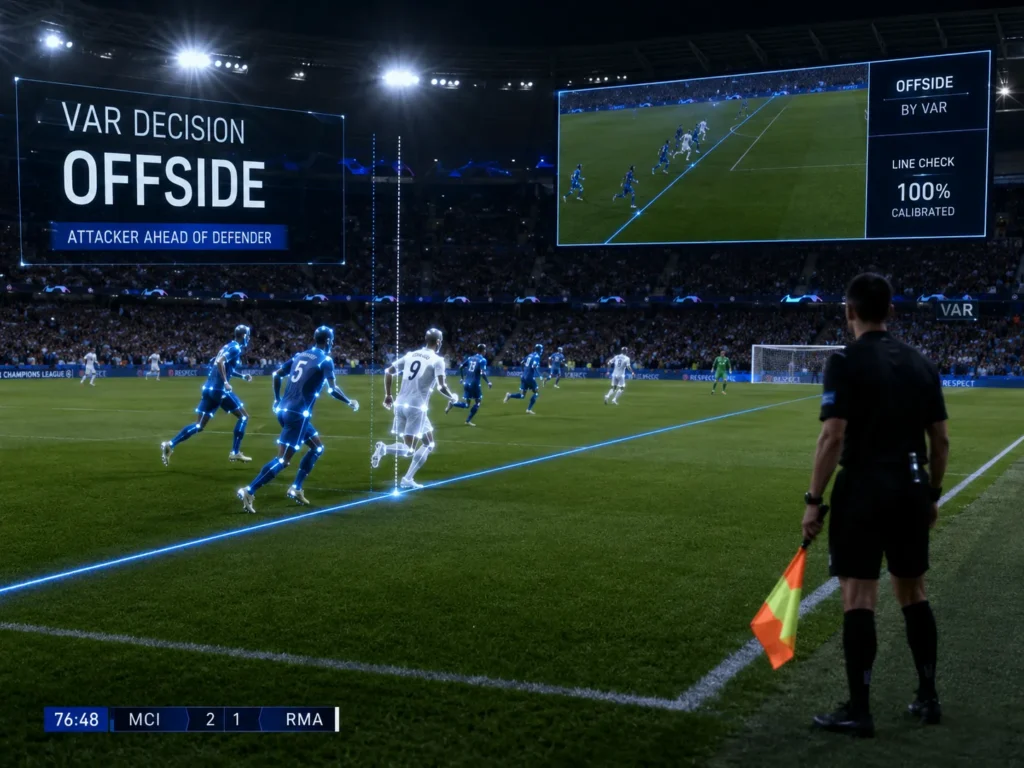
FIFA says Advanced Semi-Automated Offside Technology will be used at a men’s FIFA World Cup for the first time in 2026. The upgraded system can send clear positional offside information directly to match officials on the pitch, while more complex cases still involve VAR interpretation.
The big change is speed: clear offsides can be flagged faster, which keeps the match flowing and reduces the risk of players continuing dangerous actions after an offside has already happened. FIFA also explained that the system is limited to positional offside and does not automatically decide interference in play.
That distinction is important. This is not a robot referee making every decision. It is an AI-supported evidence system that gives human officials better information faster.
For fans, the most visible upgrade is the 3D replay. FIFA says every participating player will be 3D-scanned, with digital avatars added to the offside system and broadcasted 3D replays. That should make it easier to understand which body part was offside and which player was involved.
In a knockout game, this could decide everything. A late winning goal might stand because the attacker was level by a toe. Or a stadium celebration might stop because the system catches a shoulder ahead of the last defender.
2. Adidas Smart Ball Trionda and Connected Ball Data
The official match ball is no longer just leather, panels, and design. In 2026, the Adidas smart ball Trionda is part of the decision network.
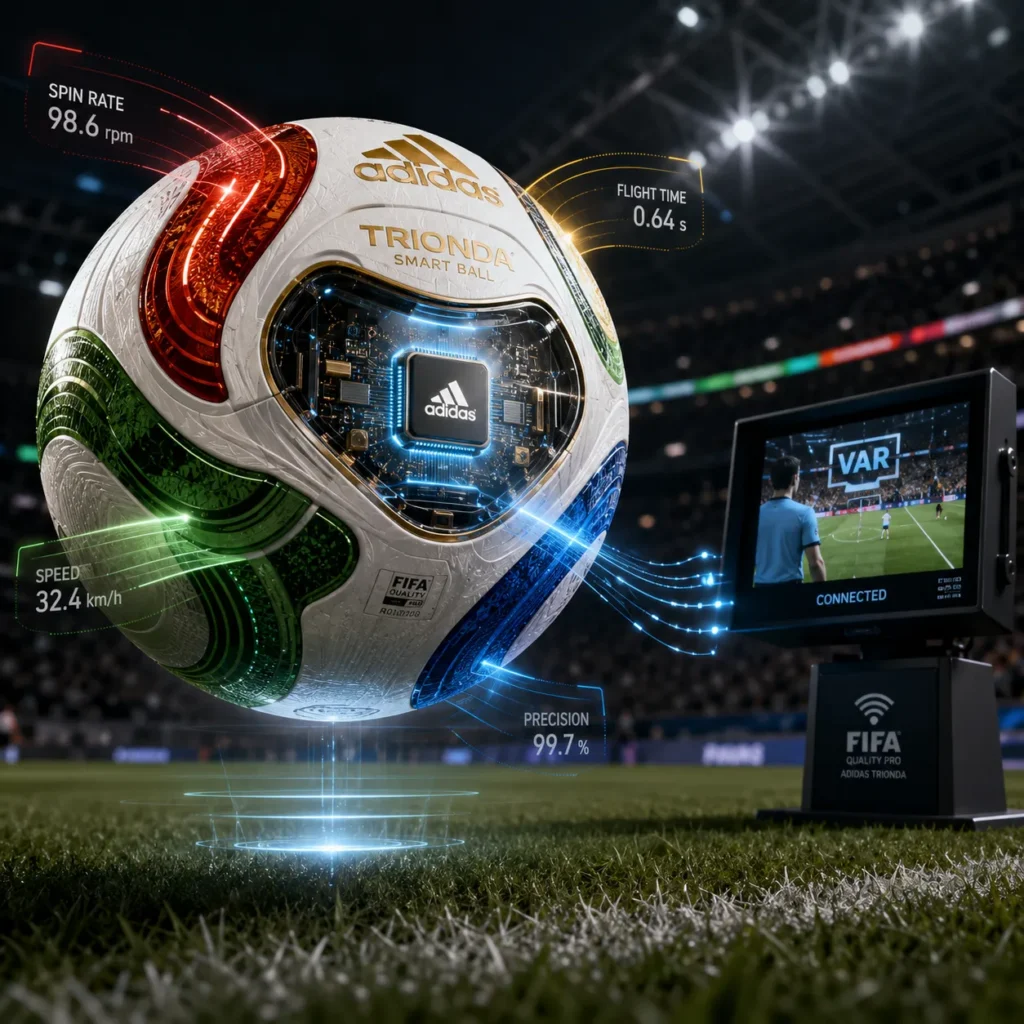
Adidas says Trionda includes the latest evolution of its connected ball technology, with a 500Hz motion sensor chip sending precise ball data to the VAR system in real time. That data can help officials make faster offside and handball decisions.
FIFA also says connected ball technology helps semi-automated offside systems by identifying the kick point, meaning the exact moment when a player contacts the ball. That matters because offside is judged at the moment the ball is played, not when the attacker receives it.
The ball is becoming a live sensor, and that changes how accurately football can measure the moment that decides a goal.
Think about a fast counterattack. The pass is made in a blur. The attacker times the run perfectly, or almost perfectly. Human eyes may not agree on the exact frame when the ball was touched.
A connected ball can help locate that decisive instant. Combine that with player tracking, and the system gets a much clearer picture of where everyone was when the pass happened.
This is why connected ball technology is one of the most important World Cup 2026 innovations. It links the physical ball to the digital referee room.
3. World Cup AI Referee Support and VAR Intelligence
The phrase “World Cup AI referee” sounds like a robot with a whistle. That is not what is happening. The referee remains human, but the information around the referee is becoming faster, richer, and more visual.
FIFA confirmed that goal-line technology, advanced semi-automated offside technology, connected ball technology, and Referee View will support match officials at the 2026 World Cup. It also said AI-powered stabilization will improve referee body-camera footage in real time, reducing motion blur from rapid movement.
The real revolution is not replacing the referee; it is giving referees better evidence under extreme pressure.
VAR already changed football by allowing officials to review goals, red cards, penalty decisions, and mistaken identity. But VAR can still feel slow and unclear to fans. AI-supported tools aim to fix that gap.
The system can support referees in several ways:
- Faster offside evidence through advanced SAOT
- More precise ball-contact timing through connected ball data
- Goal-line confirmation when the ball crosses fully
- Referee View angles for broadcast transparency
- 3D reconstructions for difficult spatial decisions
This does not remove controversy. Football still has subjective moments: handball interpretation, foul intensity, blocking a goalkeeper’s line of sight, and whether an offside player interferes with play. But the factual parts of the decision can become cleaner.
For a referee in a World Cup quarterfinal, that matters. Better data can reduce guesswork and make the final decision easier to defend.
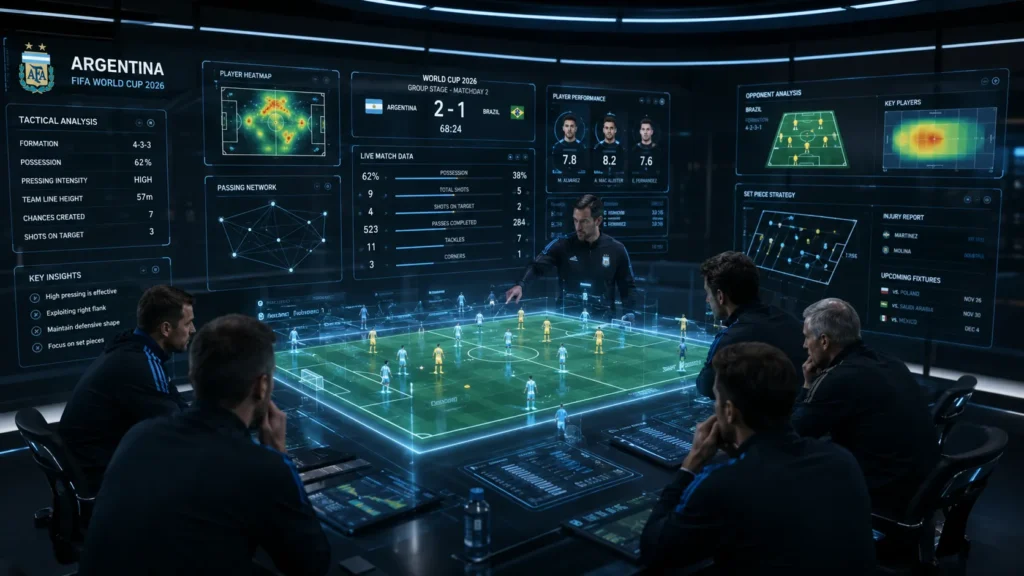
4. FIFA Football AI Pro for Team Analysis
The most powerful AI at World Cup 2026 may not appear on the broadcast at all. It may sit inside team analysis rooms.
FIFA Football AI Pro is a generative AI knowledge assistant developed with Lenovo for match analysts and coaching staff. FIFA says it focuses on analytical insights and report generation from official match data.
FIFA has explained that Football AI Pro gives all 48 participating teams access to advanced pre- and post-match analysis capabilities. Previously, teams could receive long match reports, but those reports still required expert interpretation. FIFA says the AI assistant helps teams extract the information they need faster.
This is the hidden AI battle: coaches are not only watching matches anymore; they are querying them.
A coach could use AI analysis to identify pressing traps, passing lanes, player fatigue patterns, defensive gaps, and repeated build-up weaknesses. The advantage is not only having data. It is turning that data into decisions before the next match.
For smaller nations, that could be huge. Rich federations can bring large analytics teams. Smaller teams often cannot. By making Football AI Pro available to all 48 teams, FIFA is trying to democratize tactical intelligence.
Imagine a team preparing for a favorite. The AI assistant highlights that the opponent’s left-back moves too high after turnovers. The underdog adjusts its counterattack plan. One goal later, that insight becomes history.
5. Optical Player Tracking and 3D Match Reconstruction
World Cup 2026 is not only being filmed. It is being mapped.
FIFA says 16 optical tracking cameras are installed in each of the 16 stadiums, producing over 150 million tracking data points per match. That data allows FIFA to recreate the entire match in 3D and make that feed available to VAR.
This turns a football match into a living 3D model, where every run, block, pass, and defensive line can be reviewed from angles no normal camera can capture.
That is massive for close decisions. For example, FIFA says 3D data can help VAR judge whether an offside attacker blocked the goalkeeper’s view. It can also help determine whether the ball crossed the touchline before a goal.
These are the moments fans argue about for years. Was the goalkeeper unsighted? Did the ball go out before the cutback? Was the defender’s body position enough to affect play?
Optical tracking gives officials and broadcasters a new layer of evidence. It also gives teams new tactical data after the match.
A coach can study whether the midfield compressed properly, whether a winger stopped tracking back, or whether a striker’s pressing angles were wrong. A player can review movement patterns. A broadcast partner can turn a key goal into a 3D animated breakdown.
In other words, the match becomes searchable. That is a dramatic change for football analysis.
6. AI-Stabilized Referee View and Broadcast Transparency
Fans want to understand why decisions happen. World Cup 2026 is using technology to make that easier.
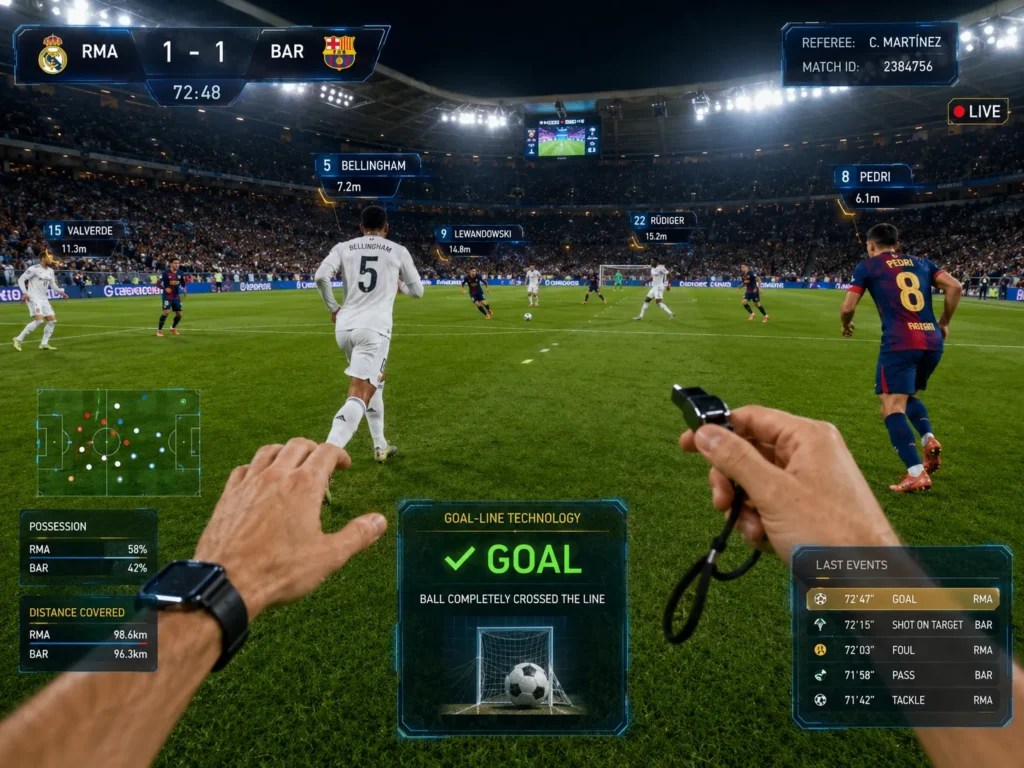
FIFA confirmed that fans will be able to see things from the referee’s on-field perspective thanks to new technologies. It also says referee body cameras build on the trial used at the FIFA Club World Cup 2025, with AI-powered stabilization reducing motion blur in real time.
Referee View does not directly award goals, but it can change how fans experience the authority and difficulty of a decision.
This matters because trust is part of modern football. When viewers only see a slow-motion replay from a perfect broadcast angle, it is easy to forget how chaotic the moment looked to the referee on the pitch.
A stabilized referee perspective can show:
- How close players were to the official
- Whether the referee’s line of sight was blocked
- How fast the contact happened
- What the official could realistically see live
- Why VAR support was necessary
That does not mean every fan will agree. Football fans rarely agree. But transparency can reduce confusion, especially when paired with 3D recreations and clearer broadcast explanations.
For tech fans, Referee View is also a preview of where live sports broadcasting is heading. The future is not only more cameras. It is smarter cameras, AI-enhanced video, and more immersive angles.
7. Player Data, Tactical Replay, and Real-Time Match Intelligence
The final game-changing layer is the data ecosystem around players and staff. World Cup 2026 is not simply about isolated referee tools. It is about connecting match footage, optical tracking, tactical replay, medical review, player performance, and media systems.
FIFA’s innovation platform lists tools such as the Player App, football data ecosystem, tactical and medical replay application, automated event data collection, optical tracking, and commentator information systems. These tools show how football is moving toward a connected match-intelligence environment.
The edge is no longer only physical; it is informational.
A team that understands its data faster can adjust faster. That might mean changing a pressing trigger at halftime, protecting a tired full-back, identifying a mismatch on set pieces, or spotting that an opponent’s center-back is turning slowly under pressure.
Player data can also influence preparation and recovery. Coaches can examine sprint loads, movement intensity, positioning, and tactical discipline. Medical staff can review incidents quickly. Analysts can turn the chaos of a 90-minute match into patterns that players can actually understand.
This is where AI technology World Cup 2026 becomes bigger than officiating. The tournament is also a test of how football organizations learn.
The best teams will still need courage, skill, chemistry, and leadership. But they will also need to convert data into action faster than their opponents.
How These 7 Technologies Could Decide Knockout Games
A group-stage mistake hurts. A knockout mistake ends dreams. That is why the biggest impact of AI technology will likely come in the most emotional matches.
A round-of-16 game could turn on a semi-automated offside flag. A quarterfinal could be shaped by a connected ball handball check. A semifinal could be won because Football AI Pro helped a coach identify a hidden weakness. A final could be remembered for a goal-line alert that confirms the ball crossed by millimeters.
The technologies are different, but they all share one mission: reduce uncertainty in moments where uncertainty is expensive.
Here is how they could decide games:
- Offside calls: Faster and more consistent positional decisions.
- Goal checks: Confirmation when the ball fully crosses the line.
- Handball and deflection reviews: Better ball-contact and movement evidence.
- Tactical preparation: AI-assisted scouting and match reports.
- In-game adjustments: Faster understanding of opponent patterns.
- Fan trust: Clearer broadcast explanations and 3D visuals.
- Player performance: Data-driven recovery, positioning, and tactical discipline.
For fans, this creates a new kind of drama. The magic is still human, but the proof is increasingly digital.
The Big Question: Is This Good for Football?
Not everyone loves more technology in football. Some fans miss the old chaos. Some worry that VAR already interrupts the game too much. Others fear that too much data could make football feel cold.
Those concerns are fair. Football is emotional because it is human.
But the strongest argument for these tools is simple: World Cup decisions are too important to depend only on a single human angle. When a player’s career, a nation’s dream, and a tournament result can change by one centimeter, better evidence matters.
The best version of football technology is invisible when it should be invisible and decisive when it must be decisive.
That is the balance FIFA is chasing in 2026. Faster offside decisions should mean fewer long delays. Better 3D visuals should mean less confusion. AI analysis tools should help smaller nations compete smarter.
Still, technology cannot solve everything. It cannot decide whether a tackle “feels” reckless in every context. It cannot guarantee fans will agree. It cannot replace the emotional intelligence of a great referee or the instinct of a great coach.
But it can make the evidence stronger. In a World Cup, that is a big deal.
Frequently Asked Questions
What AI technology is being used at World Cup 2026?
World Cup 2026 uses multiple AI-supported and data-driven systems, including advanced semi-automated offside technology, connected ball technology, Football AI Pro, optical player tracking, 3D match reconstruction, Referee View, and AI-supported broadcast tools. The goal is to improve decision speed, match analysis, fan understanding, and team preparation.
Is there a World Cup AI referee in 2026?
There is no fully automated robot referee making all decisions. The better description is World Cup AI referee support, where human officials use advanced systems such as semi-automated offside, connected ball data, goal-line technology, and AI-stabilized Referee View to make better decisions.
How does FIFA semi-automated offside technology work?
FIFA semi-automated offside technology combines player tracking, ball data, and 3D visualization to help officials judge positional offside more quickly. In 2026, clear positional offsides can be sent directly to match officials on the pitch, while subjective interference decisions still require human judgment.
What is Adidas smart ball Trionda?
Adidas smart ball Trionda is the official match ball of World Cup 2026. It includes connected ball technology with a 500Hz motion sensor chip that can send precise ball data to VAR in real time, supporting offside, handball, and touch-related decisions.
What is FIFA Football AI Pro?
FIFA Football AI Pro is an AI-powered analysis assistant created for match analysts and coaching staff. It helps teams work with official match data, generate insights, and prepare more effectively before and after games.
Conclusion: Football’s AI Era Has Officially Arrived
AI technology World Cup 2026 is not a side story. It is part of the tournament’s competitive DNA.
From FIFA semi-automated offside technology to Adidas smart ball Trionda, from the World Cup AI referee support layer to FIFA Football AI Pro, the 2026 tournament shows how deeply data is now woven into elite football. The result is a faster, smarter, more transparent version of the game.
Will technology remove every argument? Absolutely not. This is football.
But it will change which arguments matter. Instead of guessing where the line was, fans will see the 3D replay. Instead of wondering when the ball was touched, VAR can use connected ball data. Instead of relying only on massive analyst teams, coaches can use AI tools to find patterns hidden inside the match.
The beautiful game is still beautiful. It is just becoming more intelligent.
Want more football tech breakdowns? Read our full guide to FIFA World Cup 2026 technology on tech-play.net and follow Tech Play for more AI, app, gaming, and sports-tech stories.