
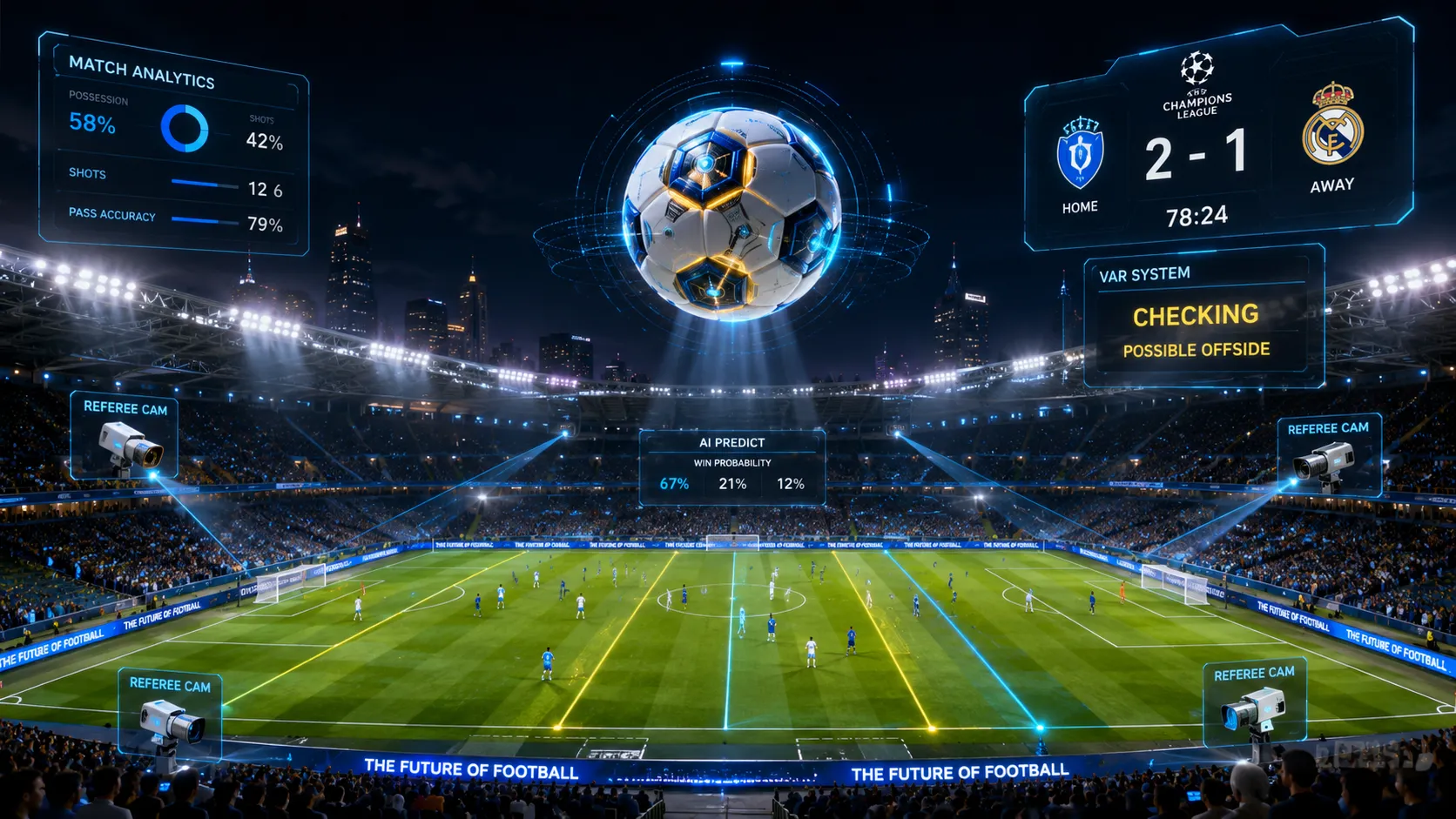
The FIFA World Cup 2026 technology story is not only about better cameras or cleaner TV graphics. It is about football becoming faster, smarter, more transparent, and more data-driven while millions of fans watch every touch.
This tournament is bringing together smart football 2026 systems, AI offside detection, connected match balls, referee cameras, and advanced team analysis tools. In simple words: the beautiful game is getting a serious software update.
FIFA World Cup 2026 Technology Is Changing the Match
The 2026 tournament is taking place across Canada, Mexico, and the United States from June 11 to July 19, 2026, and FIFA has described several major technology upgrades for referees, teams, media partners, and fans. The biggest change is that technology is moving from “behind the scenes” into the live football experience.
In previous tournaments, many fans only noticed technology when VAR stopped the game. In 2026, the tech is more visible, more connected, and more useful for explaining what is happening on the pitch.
The goal is not to turn football into a video game. The goal is to reduce confusion, speed up decisions, and make the broadcast more immersive.
That is why the tech stack matters. The ball, the players, the cameras, the referees, and even the tactical analysis tools are becoming part of one connected match environment.
[INSERT IMAGE 1 HERE]
(Image: Futuristic stadium showing smart ball, VAR lines, and AI overlays)
The Smart Football 2026 Upgrade: Adidas TRIONDA
One of the most exciting upgrades is the official match ball: TRIONDA. Adidas says the ball celebrates the three host nations, with red, green, and blue design elements representing Canada, Mexico, and the United States.
But the design is only half the story. The real magic is inside the ball.
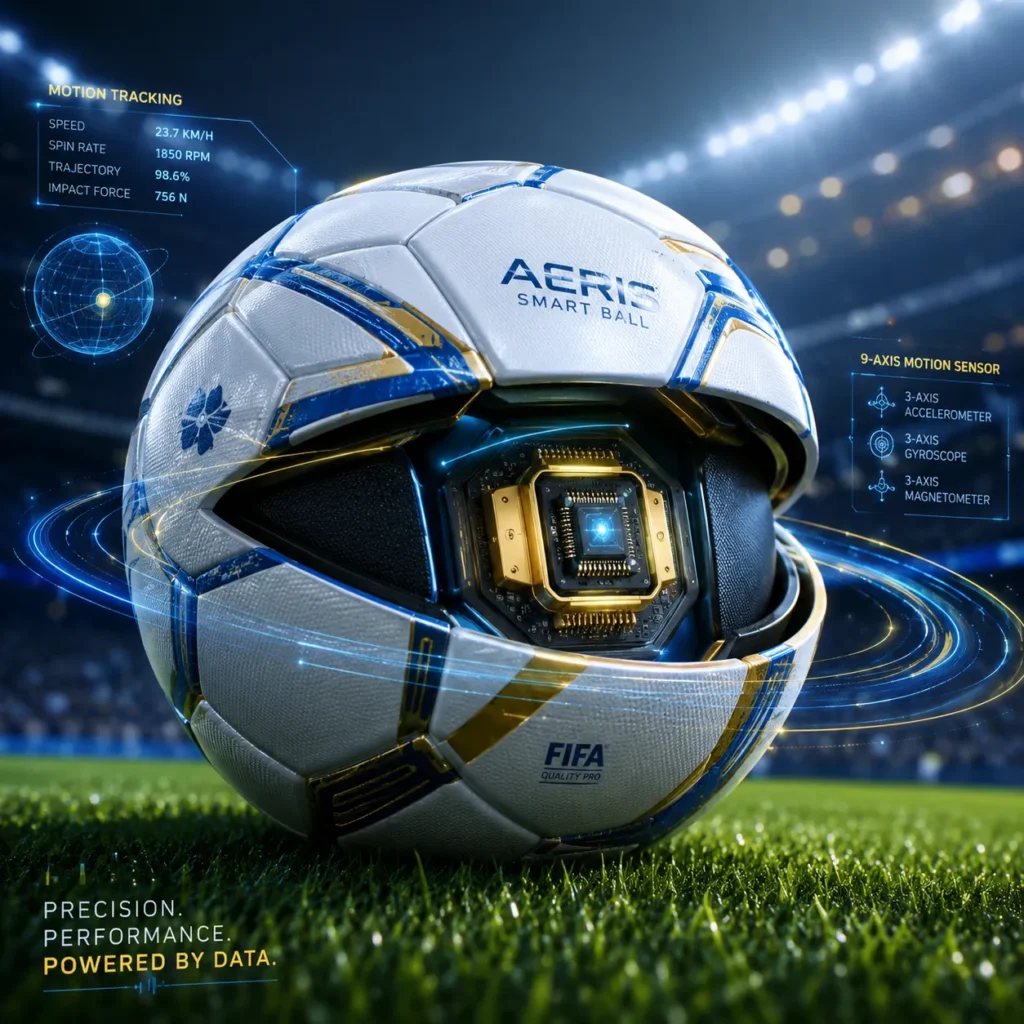
The Match Day TRIONDA football uses adidas Connected Ball Technology with a 500Hz inertial measurement unit motion sensor chip. According to adidas, this chip sends precise ball data to the VAR system in real time, helping officials make faster offside decisions when combined with player-position data and AI.
This is why the Adidas Trionda sensor is such a big deal. It can help detect the exact moment the ball is touched, which is crucial for offside checks, handball reviews, and deflection situations.
For fans, this technology may be invisible during normal play. But during tight decisions, it can become one of the most important pieces of equipment in the entire stadium.
Why the Adidas Trionda Sensor Matters
Traditional football decisions depend heavily on camera angles and human interpretation. That will still matter, but the smart ball adds another layer of data.
The sensor can support officials by helping answer questions like:
- When exactly was the ball played?
- Was there a touch or deflection?
- Did the ball movement match what the cameras showed?
- Can VAR confirm an offside moment faster?
This does not mean the ball “decides” the game. The referee and VAR team still matter. But the ball can provide cleaner data at moments where milliseconds and centimeters can change everything.
VAR Technology 2026: Faster, Clearer, Smarter
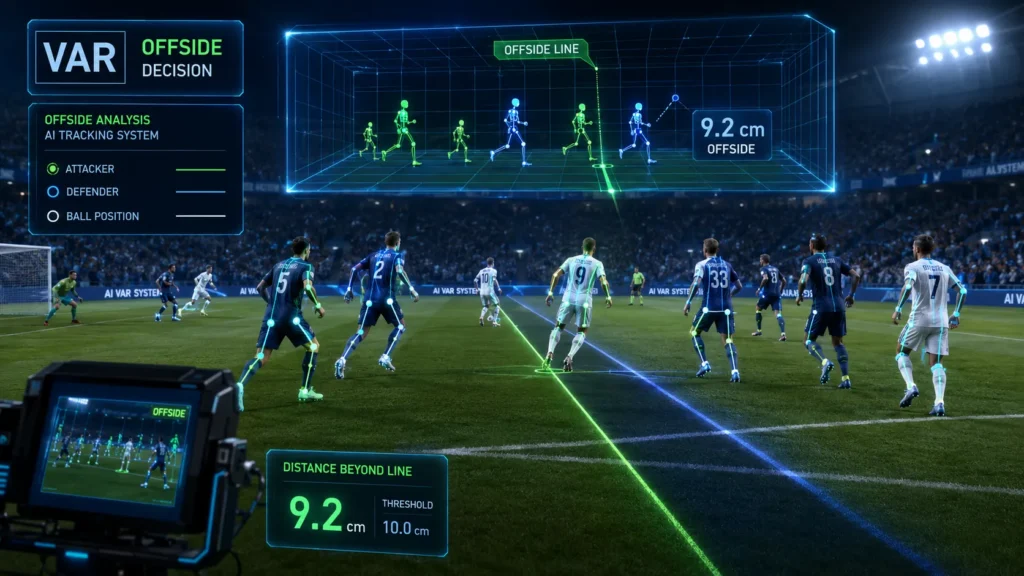
VAR technology 2026 is not just the same old video review system with a new label. FIFA says Advanced Semi-Automated Offside Technology will be used for the first time at a FIFA World Cup, and clear positional offsides can now be sent directly to match officials on the pitch.
That is a big shift. Instead of waiting through long delays, assistant referees can receive faster support for clear offside positions.
In Qatar 2022, semi-automated offside information was sent to the VAR. For 2026, FIFA explains that clear offsides can be sent directly to on-field officials, which should make obvious calls quicker.
This matters because one of the most frustrating things in modern football is the delayed flag. A striker runs 30 meters, the crowd gets excited, the attack finishes, and only then does everyone discover the move was offside.
Advanced AI offside detection is designed to reduce that kind of wasted moment, at least for clear positional offsides.
AI Offside Detection and 3D Player Scans
FIFA also says every participating player at the 2026 World Cup will be 3D-scanned, with digital avatars included in the semi-automated offside system. These avatars can improve broadcasted 3D replays and make it clearer which players are involved in an offside position.
That sounds very futuristic, but the idea is simple. Instead of showing fans a confusing flat line and a frozen image, the system can create a clearer 3D replay.
The best technology is not only accurate — it is understandable.
If fans can quickly see why a decision was made, the game feels less interrupted. That is important because football lives on emotion, and long confusing checks can kill momentum.
The system still has limits. FIFA notes that the improved system is for positional offside and does not automatically decide interference in play for an offside player who does not touch the ball.
That is a key point. AI can assist, but football still has gray areas where human referees must interpret the Laws of the Game.
Referee Camera World Cup: Seeing the Game From the Official’s View
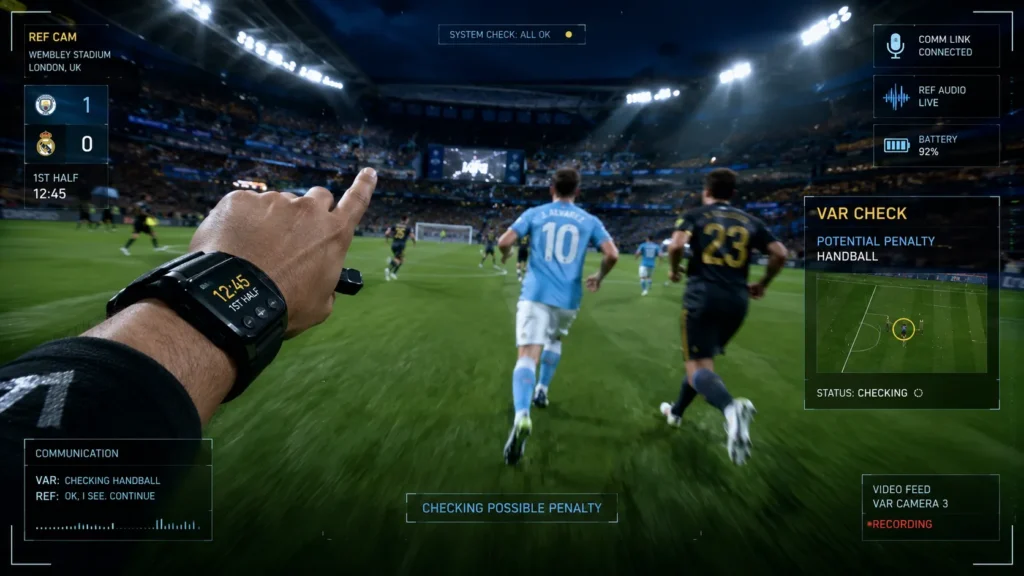
The referee camera World Cup feature may become one of the most talked-about broadcast upgrades. FIFA says referee body cameras were first used at the FIFA Club World Cup 2025, and Lenovo has developed technology to reduce motion blur and deliver more stable first-person footage for global audiences.
This is not just a cool camera gimmick. It gives fans a new appreciation for how fast and chaotic football looks from the referee’s position.
Think about a penalty-box scramble. From the TV angle, viewers may see a clear replay after the moment. But the referee sees bodies, movement, blocking players, noise, pressure, and speed all at once.
The ref cam can show that perspective. It can make the viewing experience more immersive and help fans understand why some decisions are difficult in real time.
FIFA Referees Committee Chairman Pierluigi Collina said the use of ref cam at the FIFA Club World Cup 2025 went beyond expectations, adding that it was useful not only for entertainment but also for referee coaching and explaining why something may not have been seen live.
That is a very important detail. Ref cams are not only for fans. They can also become training tools for officials.
Why Ref Cam Could Change Sports Broadcasting
The referee camera brings football closer to gaming-style viewing. It creates a first-person experience that feels more intense than a normal wide broadcast angle.
For broadcasters, it can add new replay options:
- First-person views of goals
- Close-up views of challenges
- Referee perspective during set pieces
- Better explanation of blocked sightlines
- More immersive highlight packages
Used carefully, it can make football more transparent. Used too much, it could feel distracting. The balance will be important.
16 Stadiums, Optical Tracking, and 150 Million Data Points
FIFA says each of the 16 stadiums will have 16 optical tracking cameras producing more than 150 million tracking data points per match. This data allows FIFA to recreate the entire match in 3D and make that feed available to VAR.
That is a huge amount of information. The pitch is becoming a live data map.
This tracking can help with more than offside. FIFA explains that 3D data may help VAR judge whether an offside player is interfering with play, such as blocking a goalkeeper’s view. It can also help determine whether the ball crossed the touchline before a goal.
For fans, this could lead to better visual explanations. For analysts, it opens the door to deeper tactical understanding.
Imagine watching a replay where you do not only see the ball. You see pressing shapes, defensive lines, sprint runs, passing lanes, and player spacing in 3D.
That is where football analysis becomes more accessible. What used to be hidden inside professional analysis software can become part of the public broadcast experience.
Football AI Pro: AI for All 48 Teams
FIFA is also introducing Football AI Pro, a generative AI knowledge assistant designed to give all 48 participating teams access to advanced pre-match and post-match analysis.
This may be one of the most underrated parts of the FIFA World Cup 2026 technology package. AI is not only helping referees — it is helping teams understand the game faster.
FIFA says teams previously received long data reports that needed specialist analysts to interpret. Football AI Pro is designed to make it easier for teams to extract useful insights from that data.
That matters because not every national team has the same budget, staff, or analysis department. A major football nation may travel with a huge group of performance experts. A smaller nation may not.
If AI tools make advanced analysis easier to access, the technology could help level the preparation gap between teams.
What Teams Can Learn From AI Match Analysis
AI match analysis can support coaches in many practical ways. It can turn huge amounts of tracking and event data into simple questions and answers.
Teams may use analysis tools to study:
- Opponent pressing patterns
- Defensive weaknesses
- Player movement trends
- Set-piece routines
- Transition moments after losing the ball
- Post-match performance reviews
The important thing is speed. Coaches often have only a few days between matches. A tool that quickly turns data into usable insights can become a real competitive advantage.
For tech fans, this is where the World Cup becomes especially interesting. The same AI trend changing apps, search, content creation, and productivity is now shaping elite sport too.
If you enjoy discovering smart digital tools, also check out Tech-Play’s guide to the best Android apps, because the same wave of AI-powered convenience is reaching both mobile apps and global sports.
Is Football Becoming Too Technological?
This is the big question. Some fans love the upgrades. Others worry that too much technology can make football feel less human.
Both sides have a point. Technology should support football, not replace its emotion.
A fast offside decision is great. A clear 3D replay is helpful. A smart ball that confirms the exact touch can reduce arguments.
But football is still about players, pressure, mistakes, drama, and unforgettable moments. If technology interrupts too often or feels impossible to understand, fans can lose patience.
The best version of FIFA World Cup 2026 technology will be almost invisible during normal play and very useful during controversial moments. That is the sweet spot.
It should make the match fairer without making it feel robotic.
What This Means for Fans Watching at Home
For everyday fans, the biggest benefits should be clarity and immersion. You may see faster offside calls, more detailed replays, referee-perspective footage, and richer tactical graphics.
The broadcast may feel more modern, especially for viewers used to video games, live stats, and interactive sports apps. That could help younger fans connect with football in a new way.
At the same time, the core experience stays the same. You still cheer for goals, argue about decisions, and hope your team survives the group stage.
The tech is not replacing that emotion. It is adding a new layer around it.
The Bigger Picture: Football as a Tech Platform
The World Cup is no longer only a sports event. It is also a massive technology showcase.
Think about everything happening at once:
- Connected match ball data
- AI offside detection
- VAR technology 2026 workflows
- Referee camera World Cup broadcasts
- 3D player avatars
- Optical tracking cameras
- AI-powered team analysis
- Advanced broadcast graphics
That is a full digital ecosystem. The modern football stadium is becoming a connected computing environment.
This is why FIFA World Cup 2026 technology matters beyond football. The tournament shows how AI, sensors, computer vision, and real-time data can change a traditional human experience without removing the human element.
The same pattern is happening everywhere. Cars, phones, homes, factories, schools, and entertainment platforms are all becoming smarter and more connected.
Football is simply one of the most visible places to watch that transformation happen live.
Frequently Asked Questions
What technology is used at the FIFA World Cup 2026?
FIFA World Cup 2026 uses advanced semi-automated offside technology, connected ball data, referee body cameras, optical tracking, 3D recreations, and Football AI Pro. These systems help referees, teams, broadcasters, and fans understand the match more clearly.
What is the Adidas Trionda sensor?
The Adidas Trionda sensor is a 500Hz motion sensor chip inside the official 2026 match ball. It sends ball movement data to the VAR system in real time and can help with offside, touch, and possible handball situations.
How does AI offside detection work?
AI offside detection combines player tracking, ball sensor data, and 3D player models to help identify offside positions. For clear positional offsides, the system can support faster communication to match officials, while human referees still handle interpretation.
What is the referee camera at the World Cup?
The referee camera is a body or headset-style camera that shows the match from the official’s point of view. FIFA says improved stabilization helps deliver clearer first-person footage for fans and broadcasters.
Will technology replace referees in football?
No, technology is designed to support referees, not replace them. Systems like VAR, AI offside detection, and connected ball data provide extra information, but human officials still make key decisions.
Conclusion: The Smartest World Cup Yet
FIFA World Cup 2026 technology is turning the tournament into a real-world test lab for AI, sensors, smart football systems, and immersive broadcasting. From the Adidas Trionda sensor to AI offside detection and the referee camera World Cup experience, the game is becoming faster to analyze and easier to explain.
The best part? Fans do not need to be engineers to enjoy it. If the tech works well, it should make football feel clearer, fairer, and even more exciting.
Want more easy-to-read tech stories like this? Visit Tech-Play.net, explore our latest app and AI guides, and follow along as we break down the technology changing everyday life.


[…] more football tech breakdowns? Read our full guide to FIFA World Cup 2026 technology on tech-play.net and follow Tech Play for more AI, app, gaming, and sports-tech […]