

AI shopping agents are moving online retail from finding products toward getting tasks done. Amazon wants its assistant to understand your shopping life across Amazon and Alexa. Walmart is building its own assistant while connecting its shopping experience to outside AI platforms. The emerging contest is over who understands your intent, who can act on it, and who controls the purchase. These strategies build on Amazon’s connected assistant and Walmart’s agent infrastructure.
Research checked: 24 October 2026. This article focuses on US announcements and documented capabilities. Availability can depend on account, product and rollout; it does not establish availability in Austria or elsewhere. Company descriptions are attributed, and the implications below are editorial analysis rather than hands-on test results.
What changed recently?
The names matter. Rufus became Alexa for Shopping on 13 May 2026, according to Amazon’s updated product announcement. An article treating Rufus as Amazon’s separate current flagship would miss that change.
Amazon’s Alexa for Shopping announcement brings shopping assistance into its app, website and Echo Show experience. It describes product comparisons, price history and scheduled actions, with free signed-in access that does not require Prime or an Echo device.
Walmart’s path has broadened since its 14 October 2025 OpenAI partnership announcement, which initially focused on Instant Checkout. On 11 January 2026 it announced a Gemini experience using the Universal Commerce Protocol, or UCP. The proposal connected discovery to Walmart and Sam’s Club shopping, linked carts and membership benefits, beginning in the US.
The newest step is Walmart’s 21 October announcement of Agent Profiles and the Walmart Agent Gateway. Profiles were planned for the following month. Treat that as an announced rollout, not a feature already available to everyone on this article’s research date. The Gateway page offers beta-access requests, rather than demonstrating general access.
How AI shopping agents work
A conversational assistant can explain differences between products. An agent adds the ability to use tools and take authorized actions, such as building a cart or completing an eligible purchase. Autonomy is a spectrum: an answer, a proposed basket and a submitted order carry very different consequences.
A typical journey has four stages:
- Understand the request. Turn “help me buy supplies for a weekend camping trip” into constraints such as budget, group size and delivery date.
- Find and compare. Retrieve product details, availability and reviews, then explain suitable options. Amazon describes models drawing on its catalog, reviews, questions and web information; Walmart describes Sparky synthesizing reviews and product data.
- Prepare an action. Build a list or cart, check variants and identify missing information. Preparing a cart should not be confused with permission to pay.
- Act within permission. Execute an allowed task, then provide a confirmation and route for checking the result.
For the broader shift from browsing to delegated tasks, see Tech-Play’s guide to AI browsers and AI agents.
This is a simplified model, not a claim that both retailers use identical architectures. See Amazon’s model description and Walmart’s account of Sparky and its agent infrastructure.
Amazon’s Buy for Me explanation shows the action layer in practice. Launched as a beta in April 2025, it lets a customer request an eligible purchase from a brand’s external website. The customer confirms order details; Amazon’s agent completes the brand checkout. The brand handles delivery, returns and customer service. Shopping through an Amazon interface therefore does not make every order an Amazon-fulfilled order.
AI shopping agents: Amazon versus Walmart
Amazon: deepen the existing shopping relationship. Alexa for Shopping connects product assistance with preferences, purchase history and conversations across Amazon and Alexa. Its scheduled actions can research or add items to a cart for review, while eligible Buy for Me orders reach outside stores. That makes Amazon’s approach broader than a closed catalog, but still centered on Amazon’s interface and customer relationship. Amazon describes these capabilities here.
Walmart: bring its shopping experience into more entry points. Sparky remains central, while Walmart describes integrations with ChatGPT and Gemini alongside its own app. The strategy lets discovery begin in a general assistant and connect with Walmart’s retail systems. It does not mean every external agent gets unrestricted access. Walmart’s technology overview describes the combination of internal agents and platform partnerships.
The distinction is where the relationship begins and who manages the handoff. Neither approach proves that an assistant searches the entire market impartially or finds the lowest total price. Shoppers should still compare alternatives outside the assistant’s shortlist.
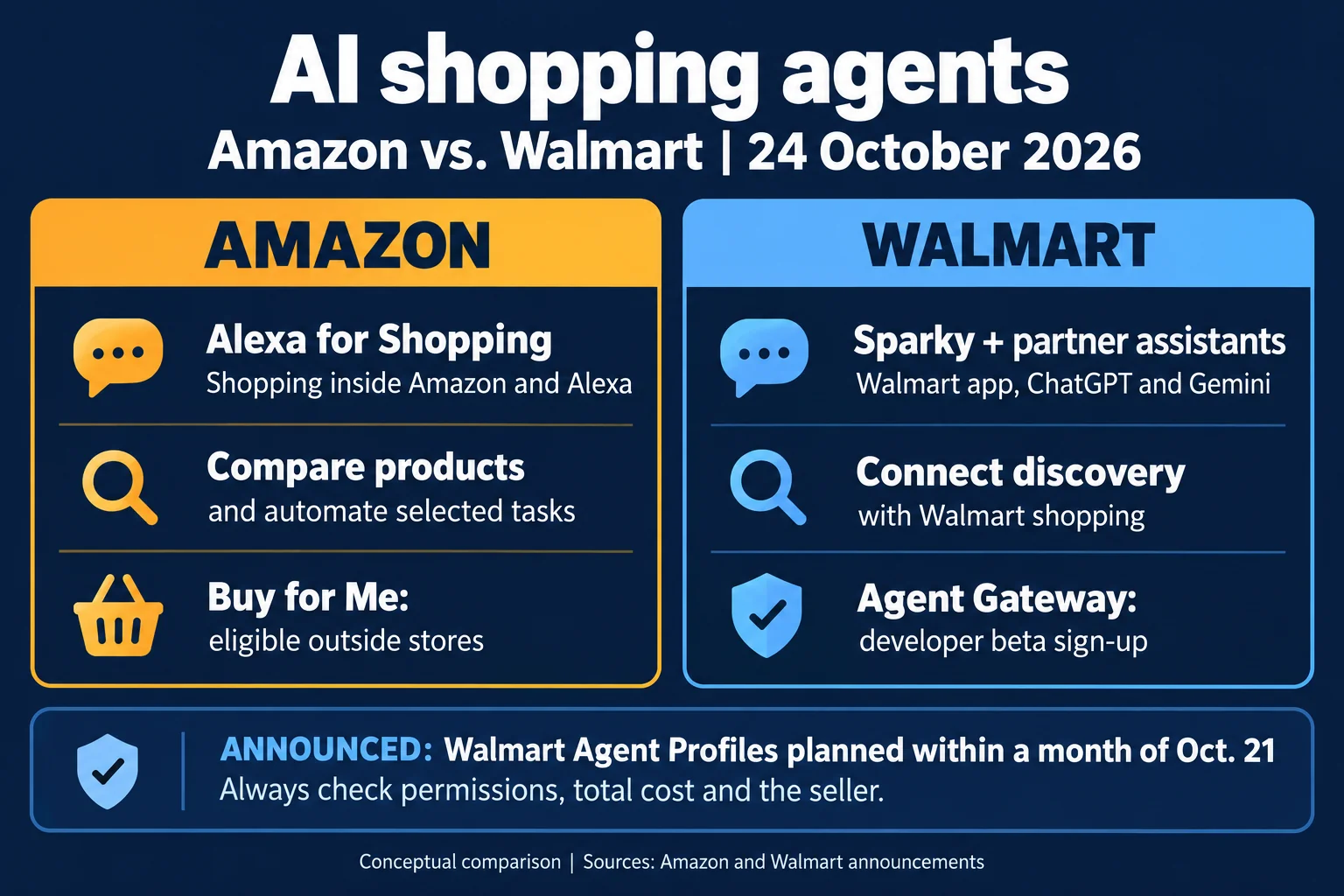
Original AI-generated comparison, checked 24 October 2026. Announced rollouts and beta access are labelled; this is not a product screenshot.
Who gets permission to shop?
The fight includes third-party access. In its November 2025 statement about Perplexity, Amazon argued that purchasing applications should operate transparently and respect a retailer’s decision about participation. It said it had asked Perplexity to remove Amazon from the Comet experience.
There is a significant later legal development: on 4 August 2026, the Ninth Circuit vacated the preliminary injunction against Perplexity and remanded the case. On the facts before it, the court distinguished a user accessing Amazon with an AI tool from Perplexity itself accessing Amazon. That ruling addressed preliminary relief; it should not be presented as a universal permission for all agents or a final resolution of every dispute.
Walmart’s announced profiles take a permission-based integration route: separate agent activity, customer-set spending limits, revocable access and purchase approval by default. Its proposed rules keep payment-card details from agents and limit access to information needed for the task. Those are Walmart’s stated controls, not independently tested security guarantees. Read the announcement and terms summary.
Benefits shoppers could actually notice
The practical opportunity is less repetitive work. A useful assistant could keep a budget in view while comparing alternatives, turn a shopping goal into a manageable list, or help replenish familiar items. Walmart’s Sparky help page describes conversational recommendations and review synthesis, while also warning that mistakes can happen.
Timing can become part of the task. Amazon documents target-price Auto Buy: a customer can authorize a purchase when an item reaches a chosen price. That differs from a notification and from adding something to a cart. Check exactly which action you are enabling.
For expensive purchases, use the assistant to narrow the research, then inspect the specifications, seller, final cost and return terms yourself. Convenience is valuable when it removes clerical work while preserving a meaningful decision.
Privacy and security: convenience needs boundaries
Personalization needs context. Amazon says shopping and Alexa conversations and preferences inform each other. That may save repeated explanations, but it makes account and memory settings worth reviewing before discussing sensitive household needs. Amazon explains the shared context and preference controls.
A partner adds another data relationship. Walmart says its Gateway will help agents find familiar items without exposing broader purchase history. It also says an agent provider’s privacy policy governs information received by that provider. A retail integration should not be read as a promise that everything typed into an outside assistant stays with the retailer. Walmart sets out these boundaries here.
Untrusted content can steer an agent. Prompt injection occurs when third-party material contains instructions that try to redirect the AI. In shopping, a plausible risk is a listing manipulating a recommendation or inducing inappropriate data sharing. This is a general agent risk, not evidence of a breach at either retailer. OpenAI’s security explanation recommends limited access, specific instructions and careful review before confirming actions.
For related reading on how much authority to give a personal assistant, see our article on trust and permissions for Meta’s Muse AI agent.
Before delegating a purchase, set a maximum total including shipping and tax; specify acceptable sizes and substitutions; review the seller and delivery address; and understand how to revoke access. Keep confirmation enabled until you trust the narrow task. These are practical editorial precautions, not a claim that any system is risk-free.
What changes for e-commerce businesses?
Our analysis is that product information becomes an operational input to an assistant, as well as a page for a human reader. Ambiguous variants, stale stock information and unclear return terms could make an agent’s recommendation or checkout less reliable.
There is already an infrastructure response. Google’s January 2026 UCP announcement describes a common language across agents, retailers and payment providers, with retailers remaining seller of record. It also introduces additional Merchant Center attributes for conversational discovery, including product-question answers and compatible accessories.
For a business, the useful preparation is concrete: maintain accurate catalog feeds, explain compatibility, keep fulfillment promises current, and test how an authorized integration handles unavailable variants and failed payments. Measure successful, wanted orders and support outcomes alongside conversion. A fast checkout that buys the wrong item is a poor customer experience.
How this could transform online shopping
The longer-term possibility is a shift from browsing individual pages to delegating a defined outcome: “prepare a basket for this event, under this budget, and ask before paying.” Retail websites would still matter for verification, detailed research, service and returns, even when discovery starts elsewhere.
Amazon is investing in continuity inside its shopping and assistant ecosystem. Walmart is investing in continuity across its own assistant and external entry points. The test for both will be whether shoppers can understand the recommendation, control the action and fix mistakes easily. Until that is clear, the best role for AI shopping agents is bounded delegation with an informed shopper in charge.
Sources
All sources below were opened and checked on 24 October 2026. Retailer announcements establish what the companies describe or plan; they do not independently establish performance, market leadership or security effectiveness.
- Meet Alexa for Shopping, your personalized, agentic AI assistant on Amazon
- Amazon’s next-gen AI assistant for shopping is now even smarter, more capable, and more helpful
- Amazon’s new Buy for Me feature helps customers find and buy products from other brands’ sites
- Walmart Partners with OpenAI to Create AI-First Shopping Experiences
- Walmart and Google Turn AI Discovery Into Effortless Shopping Experiences
- Walmart is Building for an Agentic Commerce Future
- Walmart Makes It Possible for Agents to Shop on Behalf of Customers, While Keeping Customers in Control
- Your AI agent shops better with Walmart
- Sparky
- Statement about Perplexity
- Amazon.com Services, LLC v. Perplexity AI, Inc., No. 26-1444 (August 4, 2026)
- Understanding prompt injections
- New tech and tools for retailers to succeed in an agentic shopping era