
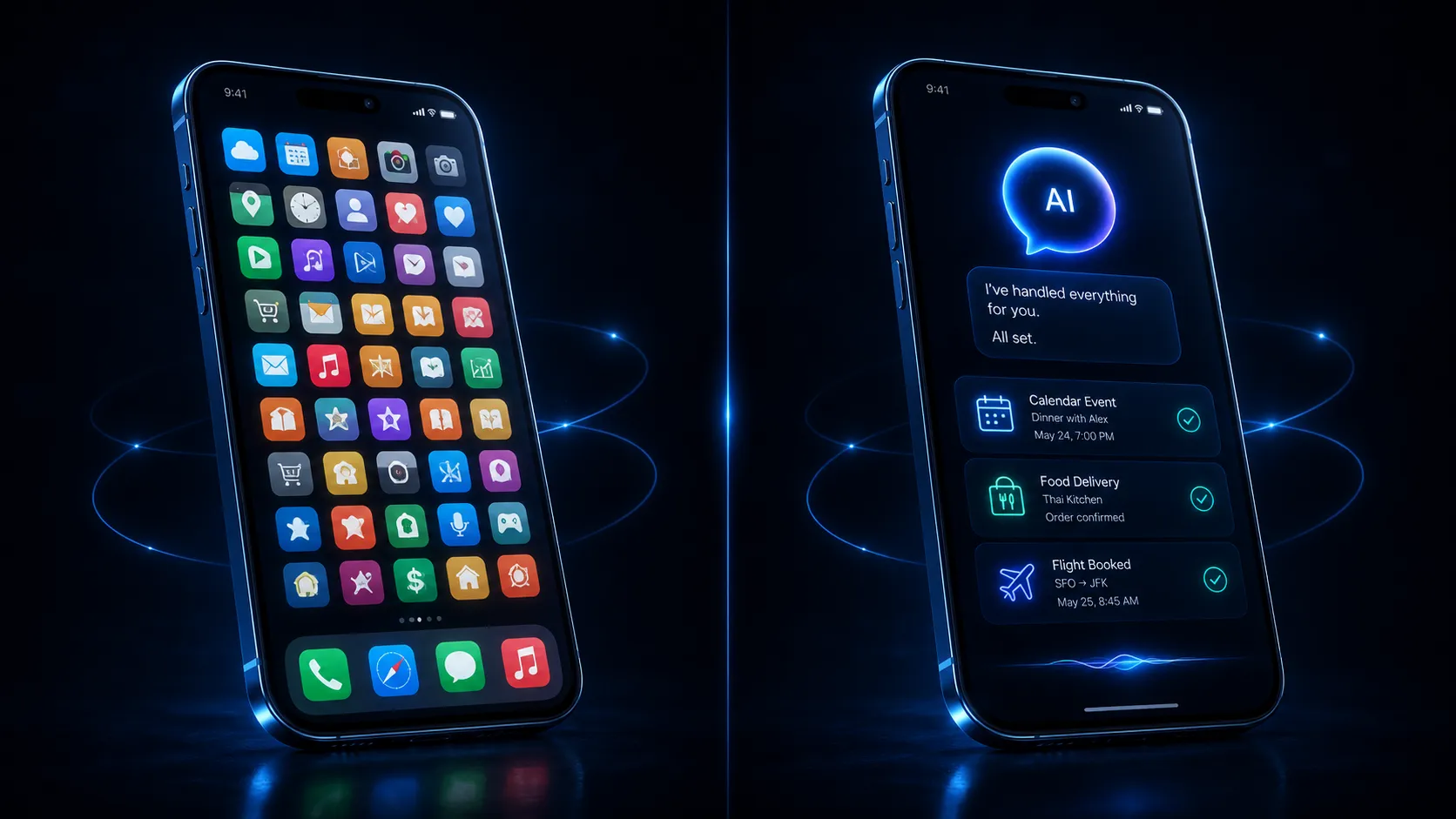
Now imagine you didn’t even need those six. That’s not a distant sci-fi scenario — it’s exactly where your phone is heading in 2026. And if you’ve been paying attention to what Google, Apple, and a dozen AI startups have been quietly building, you’d realize the clock is already ticking on the traditional app model.
AI agents are coming for your home screen. Here’s what that actually means — and why it’s a much bigger deal than most tech headlines suggest.
What Is an AI Agent, Exactly?
An AI agent is more than a chatbot. It’s a program that doesn’t just answer questions — it takes action on your behalf. It can open apps, fill forms, make purchases, send messages, set reminders, and browse the web. All you do is tell it what you want in plain language.
Think of the difference between asking someone “Where’s a good pizza place near me?” versus “Book me a table for two at the best-rated pizza place within 2 miles for 7:30 PM tonight.” The first is a chatbot. The second is an agent — and it’s what’s already inside your phone right now.
“The best interface is no interface. AI agents are making that a reality.”
The Big Players Are Already Moving
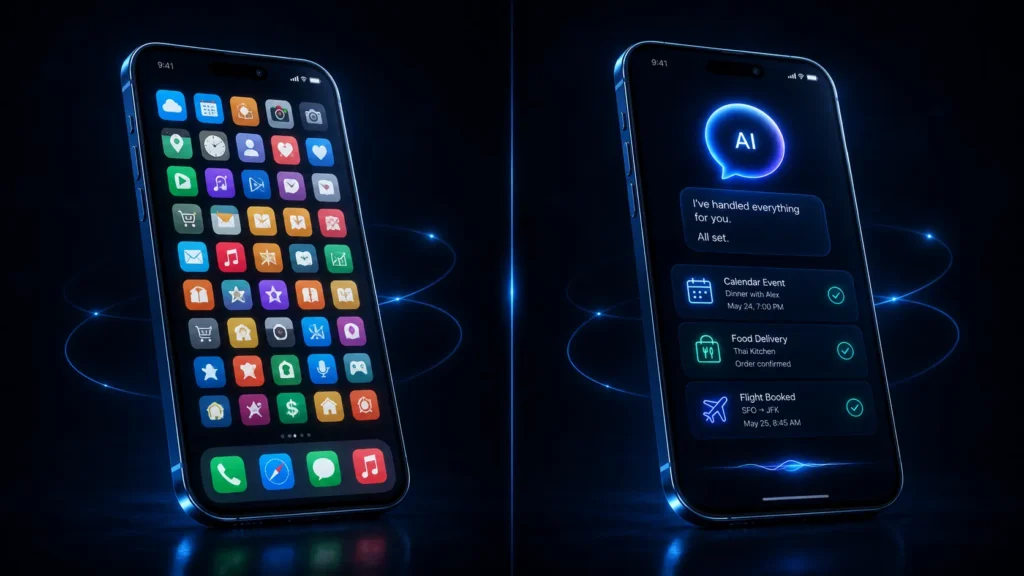
At Google I/O 2026, Google made its biggest bet yet on agentic AI. Gemini — now deeply integrated into Android — can handle multi-step tasks across apps without you ever touching them manually. Need to reschedule a meeting, update your travel itinerary, and notify your team? One sentence to Gemini. Done.
Apple isn’t standing still either. Apple Intelligence, expanded in iOS 19, can now write emails in your tone, manage your calendar intelligently, and — crucially — reach into third-party apps without you opening them. It doesn’t just suggest. It acts.
Samsung, Microsoft, and even OpenAI are racing in the same direction with their own agent frameworks. The pattern is identical: one smart interface, zero app-switching.
The Apps That Are Already in Danger
Not every app is going away tomorrow. But some categories are already feeling the pressure:
- Weather apps — your AI assistant already tells you the forecast before you ask.
- Calculator apps — you haven’t tapped one in months. You know it.
- Basic search apps — why browse results when the agent just gives you the answer?
- Simple shopping apps — AI agents can compare prices, place orders, and track deliveries across retailers.
- Travel booking apps — multi-step agentic workflows already do this better than any single app can.
The apps that survive will be the ones that do something deeply specialized — creative tools, games, platforms with communities. But the utility apps? They’re being eaten alive.
What This Means for You Right Now
Here’s the practical takeaway: you should start using AI agents today. Not because apps are dead (they aren’t yet), but because people who learn to work with AI agents now are going to save hours every week that everyone else is still spending tapping through menus.
Start with what’s already on your phone:
- Google Gemini (Android): Ask it to handle a full task — not just answer a question. Try “Add all my Amazon order confirmations from this week to a note.”
- Apple Intelligence (iPhone): Use it to draft and send messages across apps, or manage calendar conflicts automatically.
- ChatGPT with plugins/actions: For power users, set up custom GPT actions that plug into your most-used services.
The learning curve is basically zero. That’s the point. The AI learns your habits. You just describe what you want.
The Catch Nobody Talks About
There is a downside worth naming. When AI agents replace apps, they also concentrate enormous power in the hands of whoever controls the agent — Google, Apple, or Microsoft. They become the gatekeeper not just to search or the App Store, but to your entire digital life.
That’s a conversation we’re going to need to have as a society. But right now, most people aren’t even aware the shift is happening. The app-store era isn’t ending with a bang. It’s ending with a quiet “Sure, I’ll handle that for you.”
The Bottom Line
Apps aren’t dead. But the era of apps as the primary way we interact with our phones? That’s ending faster than most people realize. AI agents are cleaner, faster, and increasingly smarter than any individual app can be. The phone companies know it, the developers know it — and now you do too.
The question isn’t whether this shift is coming. It’s whether you’ll be ahead of it or catching up.
Want more takes on how AI is changing the way we use technology every day? Check out Your Phone Is Becoming an AI Assistant — And Most People Don’t Realize It Yet and AI Agents Are Coming for Your Phone — Google’s I/O 2026 Shows the Future of Apps.