Anthropic has changed Claude Code’s instructions to discourage recreating someone else’s specific game. For hobbyists and indie developers, the important distinction is that original games, genre projects and work using your own designs and assets are still intended to work.
Research checked on November 4, 2026. This is a desk-researched explainer; no hands-on refusal testing.
Use the request check below to decide what to clarify before you build, then copy the project brief into your notes.
What changed in Claude’s game-cloning restriction
Anthropic added two sentences to Claude Code’s prompt on Opus 5.5. Game Developer’s October 30 report says an Anthropic spokesperson referred it to staff member Addy Osmani’s confirmation.
The reported instruction also covers recreations renamed or presented as original. The observer dated the change to around October 27; public confirmation followed on October 30.
Osmani cited intellectual property infringement, acknowledged that the balance needed further work, and invited reports of mistaken refusals.
An instruction describes intended behavior, not demonstrated reliability. This confirmation does not establish regional rollout details, a minimum client version, or identical behavior across Claude’s web app, Artifacts and other models.
Why Anthropic is restricting specific game recreations
Anthropic’s Usage Policy prohibits using its services to violate another party’s intellectual property rights. The company presents this prompt change as an application of that policy to game recreation.
For creators, the practical concern is the difference between getting help with a design and asking a tool to reproduce another developer’s work. A request can describe familiar genre conventions while still leaving room for your own decisions. Asking for another game’s exact levels, characters and presentation gives the tool a very different brief.
Claude’s response is not a legal assessment of your project. Acceptance does not establish that you have the necessary rights, and a refusal does not establish infringement. The useful question before generation is whether you can explain what you are building and where its materials came from.
Check your game request before you generate
Work through these three questions in order. This is an editorial preparation tool, not an official Anthropic approval test:
- Are you asking to recreate a specific existing game? If yes, develop your own design before requesting a build. Renaming the same project does not address the restriction. If no, continue to the materials check.
- Can you use the code and artwork in this project? If you are unsure, identify their source and resolve permission questions before including them. Use shapes you create yourself while you establish which assets you can use.
- Can you describe the task without relying on another game’s name? If no, specify the player’s action, goal and rules. If yes, request one feature or fix with an observable result, then test it.
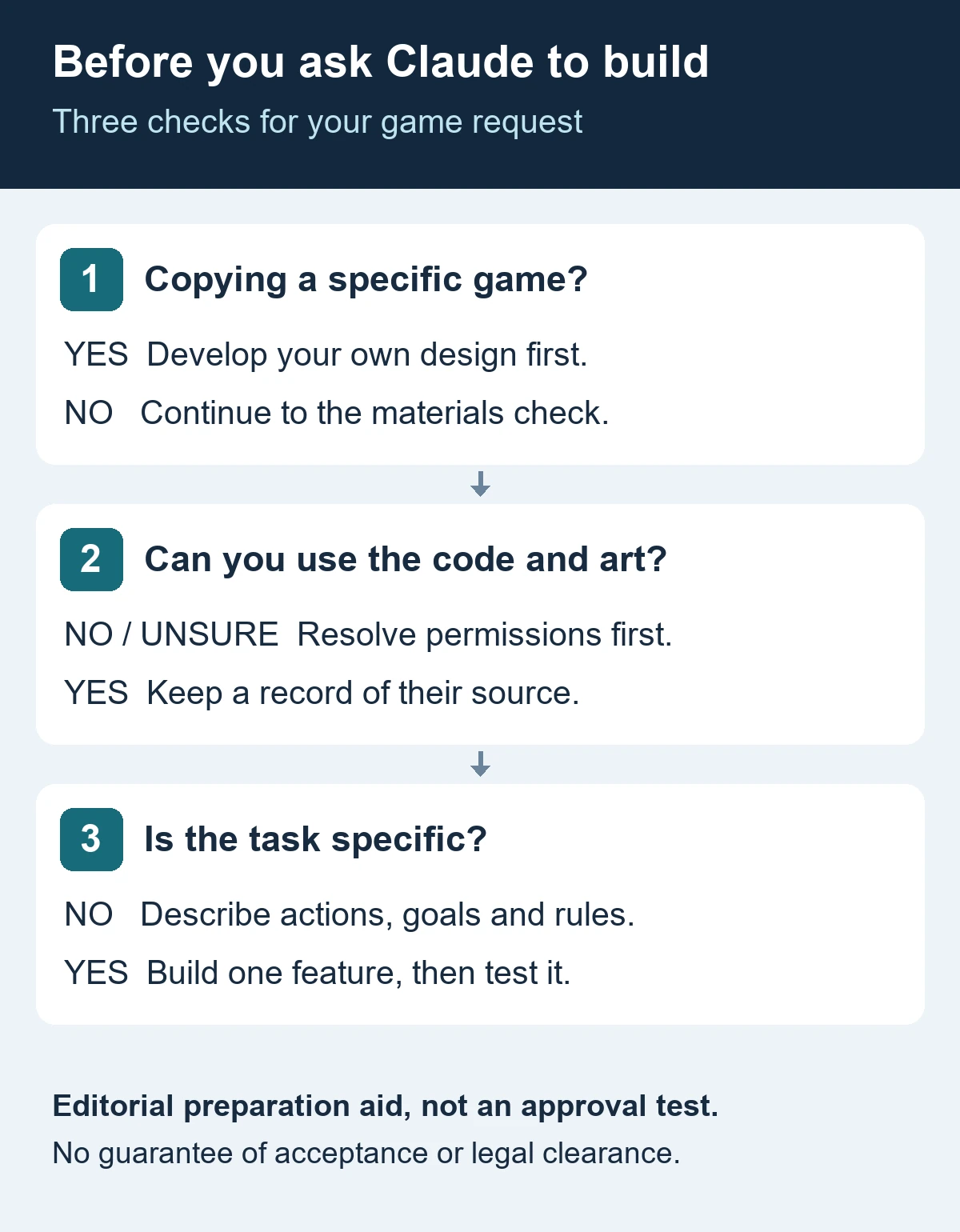
For example, “debug the jump collision in my runner using my attached source” gives the tool a task. “Recreate that commercial runner with a different hero” still asks for a recreation. A clearer brief helps you evaluate the output; it does not guarantee acceptance or establish legal clearance.
Describe your game through its own rules
If your starting prompt names a game you admire, write down what you actually want the player to do. Use those actions to develop your own brief, rather than requesting the named game with replacement artwork.
For example, replace a request to copy a particular puzzle game with a design you have worked out yourself:
Help prototype my original garden puzzle. The player places stepping stones to connect seed beds before rain fills the paths. Each turn allows one placement, and water spreads after every third turn. Start with geometric shapes I can replace with my own artwork. Ask me about missing rules before writing code. Do not reproduce another game’s levels, characters, interface or assets.
This is an editorial example, not a tested prompt or a promise that Claude will accept the task. Its value is the design information it supplies: a goal, a turn structure and a constraint you can evaluate.
Changing a theme alone is a weaker starting point. Decide how your scoring, progression or level design serves the experience you want. Those decisions also give you something useful to discuss when the prototype needs revision.
Copy this original-game brief
Fill in each line before you ask for code. Keep it with your project so you can reuse the same requirements after a failed generation:
Project name: your_project_name
Player action: what the player does each turn or moment.
Goal and ending: what counts as success, and what ends the session.
Design decision: a rule, constraint or progression choice you have worked out yourself.
Materials: code and art you created, plus any licensed materials and their permission records.
First task: one feature or bug to work on now.
Acceptance check: what you should observe when that task works.
Exclusions: features and third-party material that must stay out of this prototype.
For the garden example, the first task could be placing one stone on an empty square. The acceptance check could be that one click places one stone and clicking an occupied square changes nothing. This defines a testable step without claiming the finished puzzle has been built or tested.
For a separate build exercise, our browser-game runner challenge includes a prototype brief and checks for controls, collisions and restarts. This news concerns Claude’s copying restriction; that tutorial covers making and checking a small game.
If Claude refuses work on your own game
Give the tool accurate context about your project and narrow the request to the task you need. A request to debug a collision function in your own source code is more specific than asking it to remake a named game.
Keep this preparation checklist with your project:
- State the game’s goal and rules in your own words.
- Identify the code and assets you created, and retain permissions for material supplied by others.
- Describe the bug or feature you need help with, including expected behavior.
- Keep the refusal text and relevant project context if you report a mistaken rejection.
Do not claim ownership you do not have or conceal a recreation behind a new title. If legitimate work still fails, report the problem rather than treating repeated rewording as proof that the project complies.
Before your next coding session, write a short brief that explains your game without depending on another title. Pair it with an asset-permission record and one concrete development task. That gives you a clearer project to build, whether Claude accepts the request or you continue in your editor.